Youtuber trapped in a bubble of 'stale air' for 8 hours finally proves what our moms have been saying all along
'You're not supposed to work an eight-hour day in an environment like that because it's probably bad for your long-term health.'

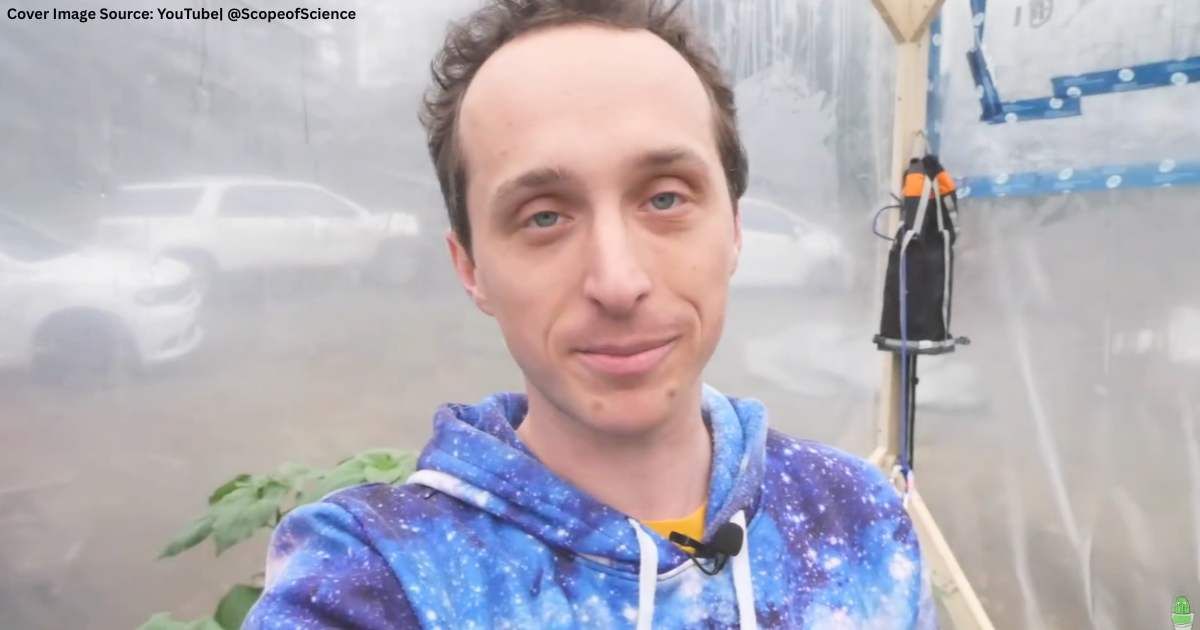
Remember the time we used to wait to run out and play? That has changed over the decades, and many today prefer sitting in their homes. Moms have to constantly urge their kids to step out and take a breath of fresh air. Turns out, mothers know best. Their theory of “fresh breath of air” is being backed up by science. A YouTuber named Kurtis Baute experimented with this idea by encasing himself in a sort of cubed structure with a stale air environment for a few hours. The results, or rather, the breathlessness, were staggering, as shown in his video. He built what he called a biodome to fit a human being. The catch? There was no ventilation.
The huge cube was made of wooden frames and plastic sheets, sealed with duct tape and silicon. Inside the dome, he placed around 200 plants, water, air monitoring equipment, some lights, and so on. In an update, he revealed that, after around five hours of being inside, he noticed a few changes. It was getting a little uncomfortable to breathe because there was more production of carbon dioxide. “The carbon dioxide level is currently 4200 parts per million, which is ten times greater than it is outdoors,” he remarked. After 11 hours of being inside the cube, things became concerning. “The air feels thick, and I feel a tiny bit light-headed,” Baute noted.
He explained that the carbon dioxide levels were at 8509 parts per million, which is dangerous. Due to this, he was having a hard time focusing. In the last part, he made some important observations. After 14 hours, the reading was 10,000 parts per million, but Baute noted that his machine could read only up to 10,000, so he had no clue if it had gone higher. The man was visibly struggling at this point and had a paramedic waiting to check him once the experiment concluded. In a video shared by an innovative enthusiast, Tom Scott, Baute once again experimented for 8 hours inside the dome. He revealed that research shows that at around 1,000 parts per million, there is a 15% decrease in cognitive functioning. This was calculated after experimenting with the decision-making capacities of employees in offices with different levels of carbon dioxide.
As he spoke from inside the dome, he was once again grappling with timing and breath to reveal the statistics. He mentioned a study that experimented on students in classrooms revealed that the latter have over 1,000 parts per million. At 1,400 ppm, the cognitive functioning decreases by 50%, and once it crosses 2,000 ppm, there are other side effects. “Some people report headaches, sleepiness, poor concentration, loss of attention, increased heart rate, and slight nausea,” he explained, adding that many bedrooms have levels at around 4,000 ppm. “You're not supposed to work an eight-hour day in an environment like that because it's probably bad for your long-term health,” he added.
We really need that ventilation more than we think. Our moms were not wrong; we do need to get out of the house much more. And to cope with this, one prominent method on the rise is stargazing, reported the BBC. Many are hopping onto the trend of stargazing to take a break from the city, exhausting and claustrophobic life, and get a taste of “tranquility.” Dark Sky Alqueva’s Rebecca Slade noted in BBC's video that this simple practice has been reported to slow heartbeats, provide relief to the eyes, and has other benefits. “Time stops and you just concentrate on nature and what's around you,” she noted. A study revealed that indoor air has a lot of HAP (household air pollutants) that can have adverse and long-term effects on health.
And it affects millions of people. There is a relative risk of “cardiorespiratory, maternal, and pediatric outcomes,” the study noted. According to the Conversation, even “burping” your homes — allowing ventilation and a gush of fresh outdoor air can work wonders. Vikram Niranjan, Assistant Professor in Public Health at the University of Limerick, who was involved in the study, noted that burping should be done when there’s little expectation of pollution and smog outdoors. But stargazing still stands as a winner.


According to data from Booking, shared by National Geographic, 62% of respondents said they were planning to stargaze during their trips. Robert Massey, deputy executive director of the Royal Astronomical Society, explained, “People want an experience that’s hard to get at home.” The mere idea of focusing on one star and then realizing there are so many more the universe holds is mesmerizing and serene. “Even when you're lying out under the stars, you do have a sense that you're suddenly very small. And the big problem you had this morning might not be so big after all,” Slade remarked, and it’s a reminder we all need.
You can follow Kurtis Baute (@ScopeofScience) on Instagram for more content on science and living.
More on Scoop Upworthy
Converse sponsors giant 'smog-eating' mural with air purification power of 780 trees
Montana youths win environment case against the state, taking one step forward to being the change
Tired of doom-scrolling? New app forces you to step outside and 'Touch Grass' — literally
 Share on Facebook


