Family joked the 'mom gene' was giving them crooked fingers until one put her face into an AI app — and cracked a 132-year-old mystery
The long-running family joke took a dark turn for Rachel, but she eventually managed to solve the mystery.

Each family has their own inside jokes, which have been running for generations. For Rachel's family, the joke was about their unique physical traits, including sparse hair and a distinct "Mom gene" chin crease named after her mother. However, that running inside joke took a somber turn when Rachel's son, Oliver, struggled with growth and faced dismissive pediatricians. Exhausted by medical dead-ends and determined to advocate for her son, she took matters into her own hands by uploading her own face to a facial analysis AI tool. The results were shocking, as they helped solve a 132-year-old mystery. She shared her journey on The Medical Detectives Podcast (@TheMedicalDetectivesPodcast) on May 13, 2025, garnering over 1,000 views.
Century-old family oddities
The roots of the conundrum began more than a century ago with Rachel's Polish great-grandfather, born in 1896, whose unique physical traits trickled down through multiple generations. Several family members shared sparse, slow-growing locks, unusual knuckles, pear-shaped noses, and much more. "We joked about how we have the mom gene," Rachel recalled how everyone treated the traits lightheartedly. This came even though, after being born prematurely in 1984, Rachel also faced health adversities growing up. This included her suffering from grade three and four urinary reflux that triggered unrelenting kidney and bladder infections.

Puzzling adulthood health troubles
These medical issues carried into her adulthood as well, after Rachel landed in an emergency room because of severe chest pain. Examinations revealed that she had postural orthostatic tachycardia syndrome. However, there was more to come. Hitting her thirties, Rachel delivered her son Oliver, a healthy baby boy. But his growth dropped sharply within the first few months; Oliver's development derailed, with him failing to meet growth milestones. Alongside this, classic signs of autism appeared, with the concerns becoming clear around 12 months, with diagnosis at 18 months, yet physicians initially brushed her worries aside. "This is horrible. I have to be able to do something. I need to now take control of the situation," she told herself.
Breakthrough via Face2Gene
She took control of the situation. However, she didn't know where to turn because medical experts had already shrugged her off. It was then that she stumbled upon Face2Gene, an artificial intelligence platform trained in dysmorphic feature recognition. It required some sort of health care access and was made for kids. Nonetheless, Rachel uploaded her face to it, and the AI flagged her for trichorhinophalangeal syndrome. "I'm like, is this app lying to me? Is this like a false hit or something like this?" She questioned.
DNA sequencing solves mystery
Discovering medical literature portraying patients who mirrored her relatives precisely, Rachel promptly uploaded Oliver's data to secure a specialized skeletal dysplasia gene panel. Weeks of compulsive portal refreshes culminated in the moment an electronic lab document signaled an unmistakable pathogenic mutation in the TRPS1 gene. "Oliver, we finally got the answers we were looking for all this time," she said with excitement as she hoped the diagnosis would help him develop as well as possible while he was still growing.
Barriers to rare disease diagnosis
This story goes to show how technology could prove to be instrumental. According to the National Organization for Rare Disorders (NORD) study, 28% of patients report medical experts taking seven or more years to identify their condition. Additionally, more than 1 in 3 patients, or roughly 38% of patients, get misdiagnosed at least once before they are correctly treated. Rachel's experience reflects that broader challenge: years of specialist visits failed to identify an underlying cause before Face2Gene provided a clue that was later confirmed through genetic testing.
Support this use of AI
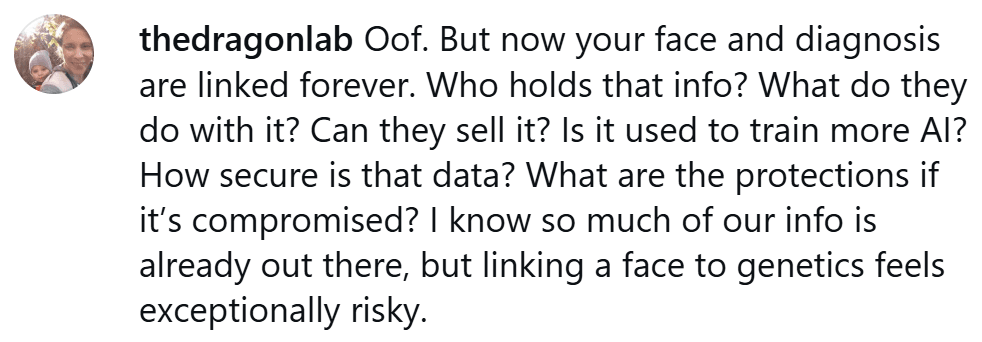

As for the people, admit all this bad news related to artificial intelligence for once; they were happy to see it being used for good. @thewellnessritual__ noted, "I fear we rely on AI FAR too much in Our everyday, and it’s probably going to be the end of us. But, in these moments? Ooooof." Meanwhile, on the other hand, @valdrake commented, "Nah, I wouldn't trust it. And it's not worth the destruction of our entire ecosystem."
More on Scoop Upworthy
Vets gave his dog months to live — a man with no biology background built an AI vaccine to save her
She panicked as ChatGPT insisted she was having a stroke. One test later, she was crying happy tears
Woman fell in love with an AI chatbot. She just updated her relationship status
 Share on Facebook