She inherited her childhood home and found a $228K water bill waiting. Then the HOA admitted 37 properties had been billed to her dad’s house
'When my father passed, I thought taking care of the house would be the easy part, but it clearly wasn't,' Moore confessed


Owning a home usually means paying for your own electricity, taxes, and water. One Baltimore woman, however, discovered that her family's property had somehow become responsible for an entire neighborhood's water bill. Kristina Moore, stepping into her family's property in Maryland's Springwood Estates, found herself in a financial ambush the moment she opened the mail. That is because, tucked among the standard paperwork, was a water bill worth over $200,000, as reported by Fox 5 News on July 15, 2026.
The shocking discovery
The ordeal began in the quiet community of Springwood Estates in Northeast Baltimore when Moore inherited a property from her father. Expecting the usual responsibilities of maintaining a family estate, she was instead faced with an administrative nightmare. "When my father passed, I thought taking care of the house would be the easy part, but it clearly wasn't," she says. She discovered a notice from the city taped to her front door, warning that if she didn't pay the staggering $228,000 water bill within the next 45 days, her service would be disconnected.

Behind the scenes
Nonetheless, soon she realized that this debt, about which she had no idea until April, couldn't be of a single home. Sure enough, that was the case. Her father's house had been structurally tied to the master water meter for the entire neighborhood, leaving one single property to inherit the community-wide debt. So, as the news spread, the focus shifted from Moore's house to the underlying mechanics of the neighborhood's utility system. According to her, this problem dates back decades to when the neighborhood was built back in the 1970s.

A fight for answers
Although a master water meter isn't uncommon in HOA communities, it is unusual to have an account tied to a single property. This is exactly what Moore and her realtor Lisa Ciofani have been arguing about. They want to know why a city billing system would allow a collective neighborhood to remain fused to an individual homeowner's deed. They are demanding the city untangle the legal knot and ensure the massive $228,000 liability is permanently stripped from the property's record, as it is taking a toll on its value.

HOA's response
As for the Springwood Estates Homeowners Association, when contacted, their president denied an interview to Fox 45 News. However, HOA president Regina Johnson confirmed that the association will be responsible for collecting the money from the residents and paying the community's water bill. However, it is worth noting that even she wasn't sure about how the balance grew to six figures. Meanwhile, Moore continues her fight against the city to get this lien off of her property despite the city denying to do so until the due is paid in full.
Utility bills are overwhelming
Well, Moore isn't the only American struggling with her utility bills. While most of the people don't have dues as high as hers, many families are drowning in utility debt. According to a study conducted by The Century Foundation (TCF) and Protect Borrowers, the rising energy and utility costs are pushing American households deeper and deeper into debt. Since 2022, the average overdue amount on utility bills has grown from $597 to a striking $789. This is a straight-up 32% increase in a matter of a few years! Additionally, about 1 in 20 households have utility debt so severe that it has been sent to collection.
Someone is not doing their job
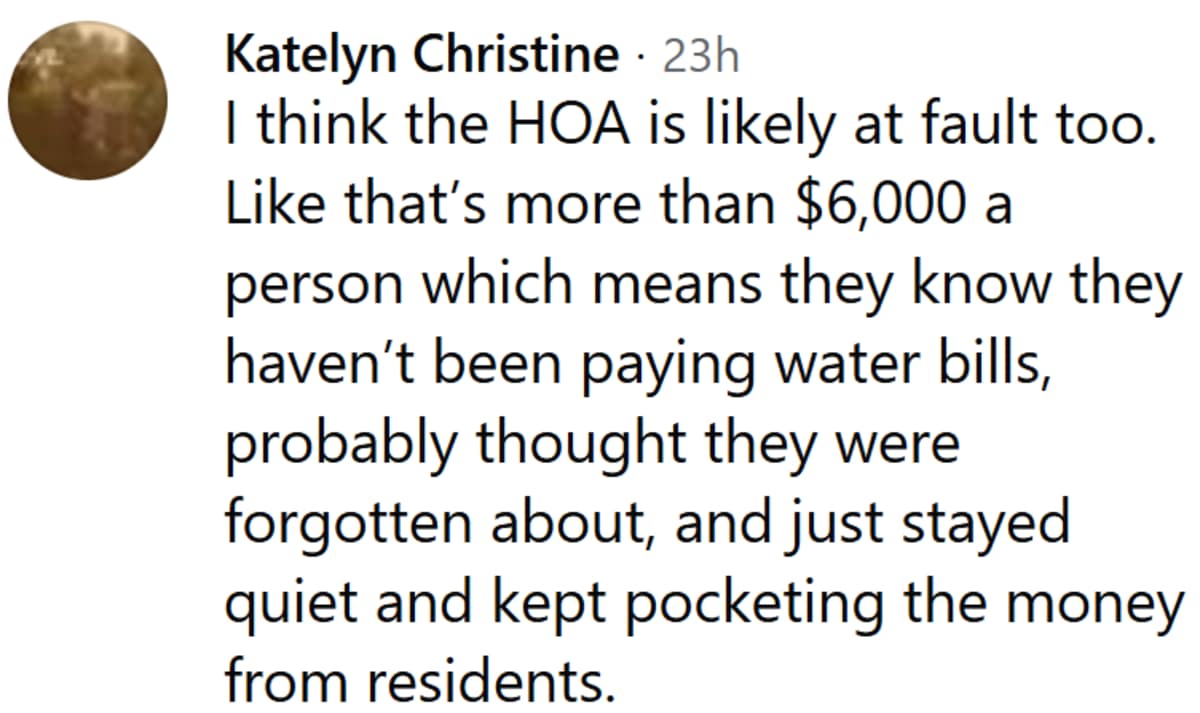
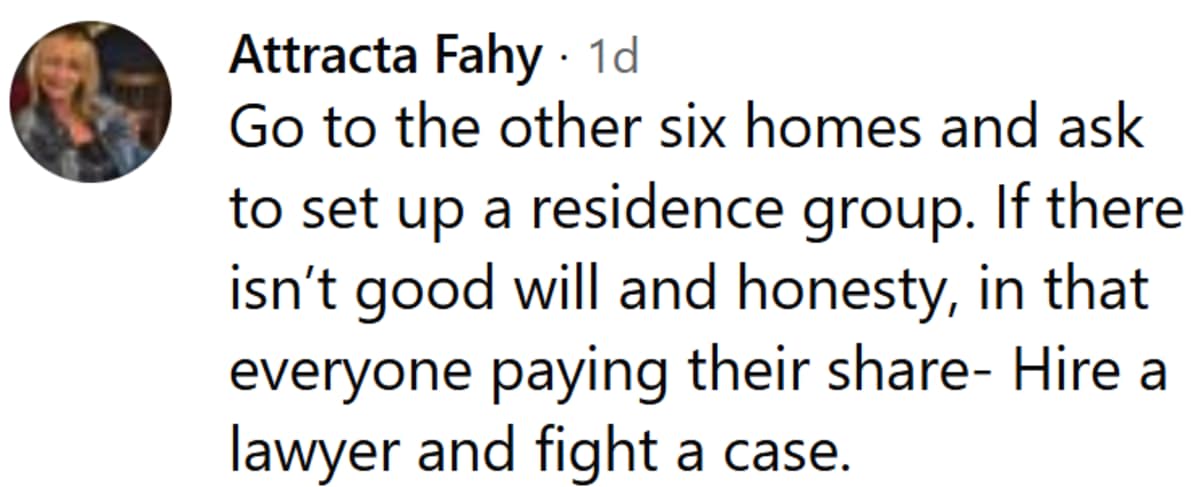
That said, people are devastated to hear about Moore's situation, as they took to a Facebook post by Rebecca Pryor TV to express their views. Marie Lillian Potter wrote, "Someone on the HOA board is not doing their job, and their books need to be reviewed by a forensic accountant." At the same time, Montana Momstar suggested, "You need a good Lawyer! Seems like the HOA is hiding something!"
More on Scoop Upworthy
Man stands up for himself after after being forced to cover restaurant bill for strangers
This article originally appeared 1 month ago.
 Share on Facebook


