Husband predicted his wife's $419K house with $3K mortgage would backfire — now that it has, he's refusing to pay a cent toward her mortgage
'I tried to keep her from dealing with this. ... I have no clue what I’m supposed to say.'


Buying a home is often viewed as a major milestone, but making a major home purchase without both partners on board can quickly create financial strain. One husband found himself caught in this exact scenario after his wife insisted on purchasing a $419,000 new-construction home completely on her own, despite his repeated belief that home prices were too high and she should wait. Now that rising costs and an unexpected relocation have left her drowning in a $3,000 monthly mortgage, he is drawing a firm boundary and refusing to foot the bill. The story has set off a heated discussion on Reddit after being posted on September 16, 2026, by u/Ratfaced_Loozer, earning 928 upvotes and 627 comments.
Wife bought a house I disagreed with and is now struggling to keep it up. I refuse to pay because I told her not to buy it from the start
by u/Ratfaced_Loozer in Marriage
‘Prices aren’t going to go down’
The conflict began when the writer's wife set her sights on owning a house as a personal achievement. Although the husband already owned a home where they lived rent-free, he helped her build up $75,000 in savings so she could pursue her ambition. However, as home prices skyrocketed, he urged her to wait for the prices to go down. But she didn't listen to him once and kept saying, "Prices aren't going to go down," and pushed forward anyway.
Seeing that she was set on the purchase, the husband made his stance clear from the start: "I don't think this is a good deal, and if you buy this house, I will not give you a single dollar towards the mortgage because I disagree with the decision". She went ahead with the purchase, and after the down payment, closing costs, and another $15,000 to $20,000 in upgrades and furnishings, she had reduced her roughly $75,000 savings to about $15,000. The writer also made it clear that they moved into the wife's new house and rented out the old one.

A year too late
Exactly a year later, she got a job opportunity that led the family to move to another state. She was then left covering the $3,000 mortgage while also paying her share of rent in their new state. The husband also noted that he covered the entire rent in the new state a few times to help her out. After months of pushback, she finally agreed to list the new home as a rental, only to discover that local market rates wouldn't even cover her monthly mortgage costs.
Desperate and out of options, she turned to her husband to complain about the mounting pressure. Refusing to bail her out, the husband stood by his original ultimatum, stating, "I tried to keep her from dealing with this... to me if you're complaining, what, am I supposed to just sit there and listen and say 'it will be ok'? That seems really fake.... I have no clue what I’m supposed to say."
More couples are keeping money separate
Keeping finances strictly separate is becoming common in the U.S. According to data from a U.S. Census Bureau survey, 23% of married couples in 2023 maintain no joint bank accounts, up from 15% in 1996. Financial research from Bankrate shows an even broader split, with 62% of American couples (including married, in civil partnerships, or living with a romantic partner) maintaining at least some financial separation, including 36% who have a mix of joint and separate accounts and 26% who keep their financial accounts completely separate.
A marriage? More like a business

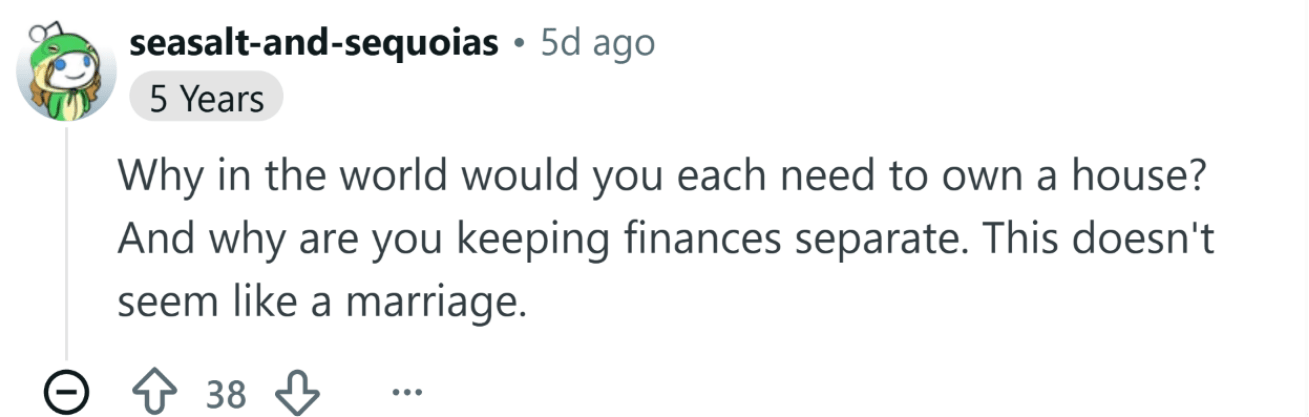
The Reddit community was largely baffled by the couple's extreme financial division, with many users questioning how a married couple with a child could operate like distant business partners rather than life teammates. While a few commentators sympathized with the wife's desire for financial independence, calling it FOMO, most pointed out that their extreme "yours vs. mine" mindset was the reason why this happened.
Calling out the bizarre nature of the dynamic, u/KMFullMonty simply asked, "Um, are you sure you're married?" Meanwhile, reflecting on the cold nature of their arrangement, u/Curious-Resort4743 added, "Marriage is more like a business contract for many these days." That said, the husband maintained that he would not routinely contribute to the mortgage, though he added that he would step in rather than actually let her lose the house.
More on Scoop Upworthy
 Share on Facebook


