New York man never knew he had a twin — until an adoption agency worker called from her deathbed to confess
'I almost drove off the road when I heard that, because that was the last thing I was ever expecting hear.'

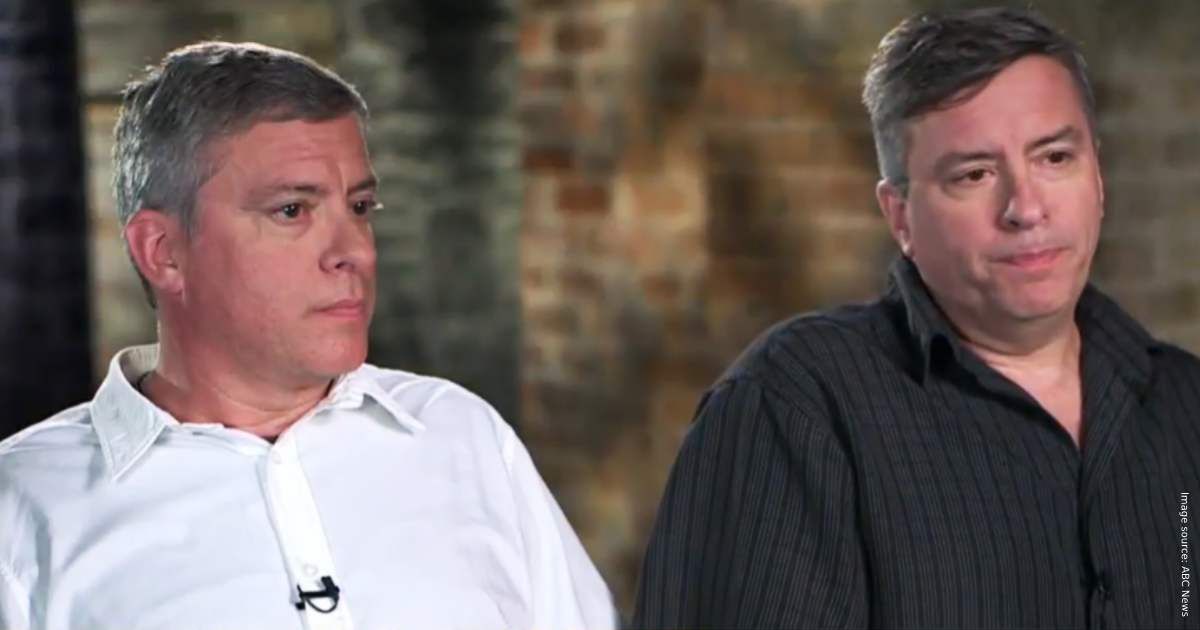
In the 1960s, scientists Dr. Viola Bernard and Dr. Peter Neubauer purposely separated twins or triplets (13 identical siblings, 5 sets of twins, and 1 set of triplets) at birth, and placed them in different adoptive families for a controversial social experiment. They basically wanted to examine the relative influence of heredity (nature) and environment (nurture) on identical siblings raised in different family atmospheres. The experiment was sponsored by three institutions: Louise Wise Services, The Jewish Board of Guardians, and Columbia University. For years, they kept it a secret and regularly visited each child to assess their overall development and compared it with their identical sibling. Doug Rausch and Howard Burack, twin brothers, were also a part of the experiment, and neither had an idea of the other's existence until they turned 35, according to ABC News. It was a deathbed call from a worker at the adoption agency that revealed the truth.
Burack and his identical twin, Rausch, were born in 1963 in New York but were soon put up for adoption. Louise Wise Services, the adoption agency, gave them to different families who strangely had similar backgrounds. Both fathers were business executives, while their wives were homemakers, and both had older sisters. For the longest time, the brothers grew up unaware of each other's existence; in fact, their adoptive parents were also not told about them. But that changed in 1998, when Burack contacted the adoption agency to request his medical information. Louise Wise Services confirmed he had an identical brother but refused to share his details with Burack. "That was tough, because every day I had that on my mind... Who's this guy? Where does he live? How do I find him?" he told OMG Stories. Two years later, a staff member from the adoption agency called Rausch and informed him that Burack, his brother, was looking for him. "She told me 'I am not supposed to do this, I can get in a lot of trouble but, I am going to do it anyway'," recalled Rausch, reported NZ Herald. "She said, 'Well I have some news for you. You have an identical twin brother'. And I literally almost drove off the road. It's not something you ever expect to hear." Rausch was left stunned, "I almost drove off the road when I heard that, because that was the last thing I was ever expecting hear."
Soon, they decided to meet, and their reunion felt like they'd known each other for years. "We pretty much hit it off, and I felt like I knew this person my whole life," Burack said. Surprisingly, both brothers had a lot in common besides their adoptive families; in fact, they had both gotten married in the same year, and even had kids the same year. Burack said he always felt like something was missing in his life, and he only understood what when he met Rausch, his identical twin.
But the real question here is, why was the experiment conducted at all? Well, it all goes back to Dr. Viola Bernard, a psychiatrist from Columbia University, who believed that twins are better off in different families. She justified her belief, saying twins who grow up together may not receive full attention from their parents and could hamper their emotional and personality development. Dr. Bernard's belief, however, was based on no scientific research or evidence. After her, various researchers have tried to determine how genetics and environment affect a child's development. For instance, T. J. Bouchard Jr., D. T. Lykken, M. McGue, N. L. Segal, and A. Tellegen analyzed more than 100 twins separated at birth and found they were almost as similar as twins raised in the same household. They revealed that nearly 70% of the variation in IQ is associated with genetic differences, while environmental factors such as parenting, education, and life experiences also play an important role. It explains why identical twins who are raised in different households still show strong similarity in personality, social attitudes, and temperament, just like Rausch and Burack.
More on Scoop Upworthy
Long-lost twins reunite with the help of social media in an extraordinary turn of events
Woman separated from family at birth due to parents' leprosy reunites with brother 53 years later
 Share on Facebook


