Scientists made people play Tetris all day, then woke them at night to test how it rewired their brains
Tetris has also been used in Trauma Care to help survivors 'rewire' those bad flashbacks.

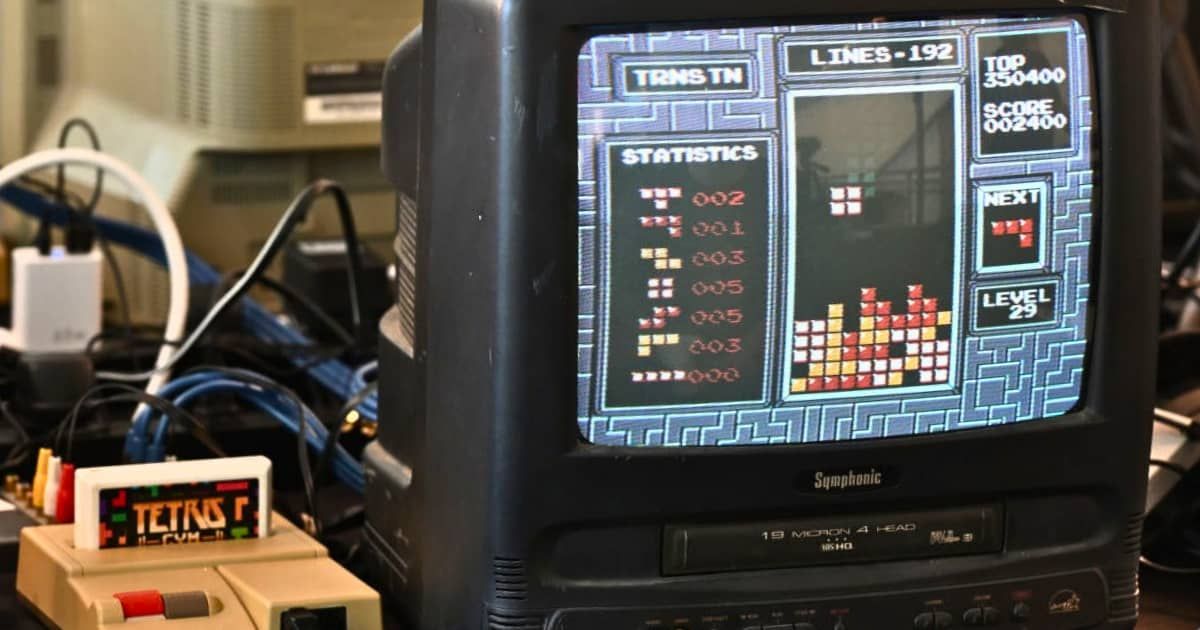
Have you tried to zoom in or target an area when you’re searching for someone in the room, as you do in video games? A mathematician named Hannah Fry (@fryrsquared) shared why this happens to the best of us. Known as the “game transfer” phenomenon, devoting too much time to playing video games can rewire your brain to structure your basic functioning in that manner. The video shared on February 25 noted how even research from Harvard backs up something called the “Tetris effect,” proving that if you’re playing video games for a long period, it can seep into your reality before you even realize it.
A study published in the National Library of Medicine Journal experimented on a group of participants with memory issues. Half of them had a normal, healthy memory, but the other half had a form of amnesia. Both were asked to play the Tetris game for hours on end. When they fell asleep at night, the participants revealed what they thought about the game or the blocks from the game. Even those with amnesia, who had no recollection of having played the game, were subconsciously thinking about it. One of the amnesiac participants forgot she was in a study, but still remembered “blocks” in her dream.
Fry called the brain “a streamlining machine,” which maintains its efficiency by rewiring based on experiences and everyday, consistent happenings. What happens when you’re playing a game for a long time is that the brain goes through a “solid hardwiring” where it decides that your game setting is the new normal. An easy example, if you’ve played “Subway Surfers,” no, you’re not going to literally jump on trains, but you will feel the pinch to jump over rocks and slide down barriers to get through. It’s funny, but it's real.

Fry mentioned that the brain goes through a process, particularly when we sleep at night, where it is resetting but also “sorting” out memories and functions. So whatever we’ve learned during the day gets registered, and when it happens for a consistent and prolonged period, it leaves that impact on your cognition. Robert Stickgold, assistant professor of psychiatry at Harvard Medical School, conducted the survey Fry quoted and was able to get the “same dream” out of all participants by just asking them to play a video game, reported Harvard Gazette.
“The fundamental purpose of sleep is to catch up on processing information received during waking hours,” Stickgold explained. That’s why when we rest, the brain resets by “clearing the inbox” of the clutter in our minds and storing the necessary parts as memories. This is then incorporated for functioning. Here’s a fun bit: it's not just for gamers; coders, writers, and anyone who spends a solid amount of time with literally anything can experience this scenario. Take, for instance, as Fry noted, you are looking for something, and you instinctively look for a “CTRL + F” option so it’s easier to find. Or you’re writing a greeting card, and after making an error, you look for the “autocorrect” option instead of striking it out.
If you’ve been swimming all day and then head to bed, you’ll feel like there are waves beneath you. Other interesting examples shared by Fry were “rocking a trolley at a supermarket because you’ve been constantly doing that for your kid” and “feeling the ground is shaky because you’ve been in the boat.” But video games really do a solid job with rewiring your brain to a point where it helps reduce traumatic memories, according to research from the University of Oxford.


Participants were trained to do “mental rotation” after thinking of a traumatic memory. This same concept was used to make them play Tetris. Because the fundamental idea of the game and the exercise were similar, it transformed the visual flashbacks associated with trauma. Instead of seeing those horrifying visuals, they instead pictured the blocks. Within a month, participants using this form of treatment showed ten times fewer flashbacks than their counterparts. Many people shared how they, too, felt the rewiring. @mick_the_knife wrote, “I've glanced at the bottom right-hand corner of a page in a book to see what the time is.” @catmarshall.art remarked, “I’m a photo editor. I tried to adjust the exposure of our dark hallway at night time recently, after a full day’s editing.”
You can follow Hannah Fry (@fryrsquared) on Instagram for more content on science and psychology.
More on Scoop Upworthy
'90s video games like 'Mario Kart' were better for children’s brains, mental health counselor claims
Guy explains how your brain is quicker to judge than your eyes
 Share on Facebook


