Tourists can't stop slapping these statues in China. The reason goes back 900 years
Yue Fei was recalled from the battlefield, only to return to his death

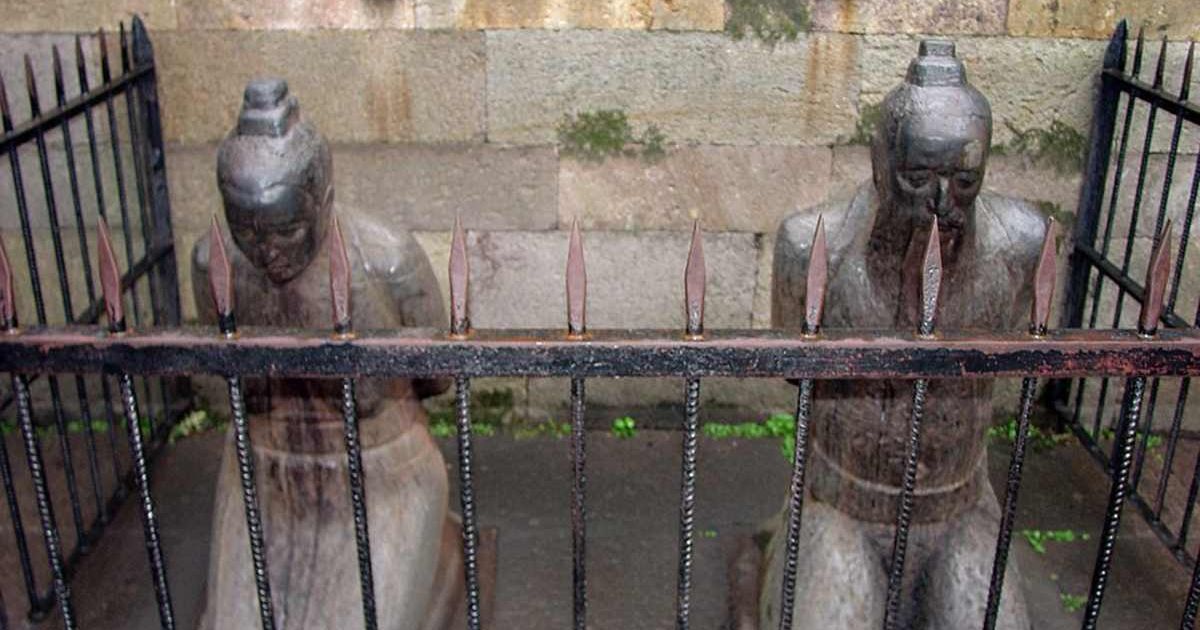
Statues are usually built to honor people who have made an impact on society. However, the kneeling statues of Qin Hui and Lady Wang are quite the opposite. Hui remains one of the most hated men in China for betraying General Yue Fei. 500 years later, people who visit Hangzhou's West Lake often stop by the statues to spit, slap, hit, or kick them. A video of the angry tourists slapping and hitting the statues was shared by The Historian (@histori.an) on Instagram on May 31, 2026. It has reached 52.3 million views, 1.2 million likes, and 7,100 comments.
He betrayed his own countrymen
It all began during the Song Dynasty (12th century) when General Yue Fei served Emperor Gaozong and was responsible for keeping the invaders from the Jin Dynasty at bay. He was known across the dynasty for his patriotism and loyalty. Qin Hui, on the other hand, was the advisor of Emperor Qinzong and Emperor Gaozong. Qin Hui desired to make peace with the invaders for his own benefit and did everything in his power to achieve it, including betraying his own countrymen.
Right before Yue Fei was about to march and reclaim the capital Kaifeng, Emperor Gaozong stopped him upon Qin Hui's advice. When Yue Fei returned home in 1137, Qin Hui and Lady Wang framed him on false charges of treason, and he was executed at just 39 years old.
Grandson's biography was a saving grace
The truth only came out in 1163, after Yue Fei's grandson published a biography. He exonerated the grandfather of his crimes and declared him a national hero. By this time, Emperor Xiaozong ruled the land, and he pardoned the late general, restoring his honor. To punish the traitorous couple, statues of Qin Hui and Lady Wang were constructed during the Ming Dynasty in the 15th century.
Why were the statues replaced 11 times?
Shirtless statues were made of cast iron, their hands behind their back, forever kneeling and facing the tomb of Yue Fei. The couple became the symbol of treason in China, and several centuries later, people are still angry. While the original statues were preserved as relics, over the years, they have been replaced 11 times. The current statues standing in Hangzhou were installed in 1979, but signs of wear and tear from the constant beating from tourists have begun to show.
A snack named after their betrayal
The hatred towards Qin Hui and Lady Wang has transcended generations of Chinese people and ingrained itself into their culture. Local guides sold sticks near the statues, encouraging tourists to beat the statues with them. According to Vice, they even invented a snack called 'yóutiáo,' roughly translating to 'oil-fried devil,' symbolizing Qin Hui and Lady Wang being deep-fried as part of their punishment. Tourists slap, spit, and hit the statues for luck, national pride, out of loyalty, or simply to join in on the ritual.
But the statues of Qin Hui and Lady Wang were not the only statues that elicit negative feelings among people. A few other controversial statues include the 'Lucifer of Liege' or 'Le genie du mal' in Belgium, the statue of J. Marion Sims, the father of modern gynecology; and the Blue Mustang, a 32-foot-tall horse next to the Denver International Airport.
One furious tourist Grandpa


People in the comments found it hilarious that one man was beating the statues with a shoe. A few others commented that the same should be done for people who have engaged in heinous acts. @fame_vbb commented, "Sending hate from Ghana to Qin Hui." @_aarav_11451 wrote, "Grandpa is really mad at someone and is taking all his anger out on them."
More on Scoop Upworthy
25 memes about history that are cracking people up
Astronaut Christina Koch didn’t like what her own statue might be telling young girls
A girl counted 14 statues and all were of men. She wrote a letter that made history
 Share on Facebook


