Why do medieval churches have stairs leading nowhere?
The majority of these 'rood staircases' and screens disappeared during the Reformation period

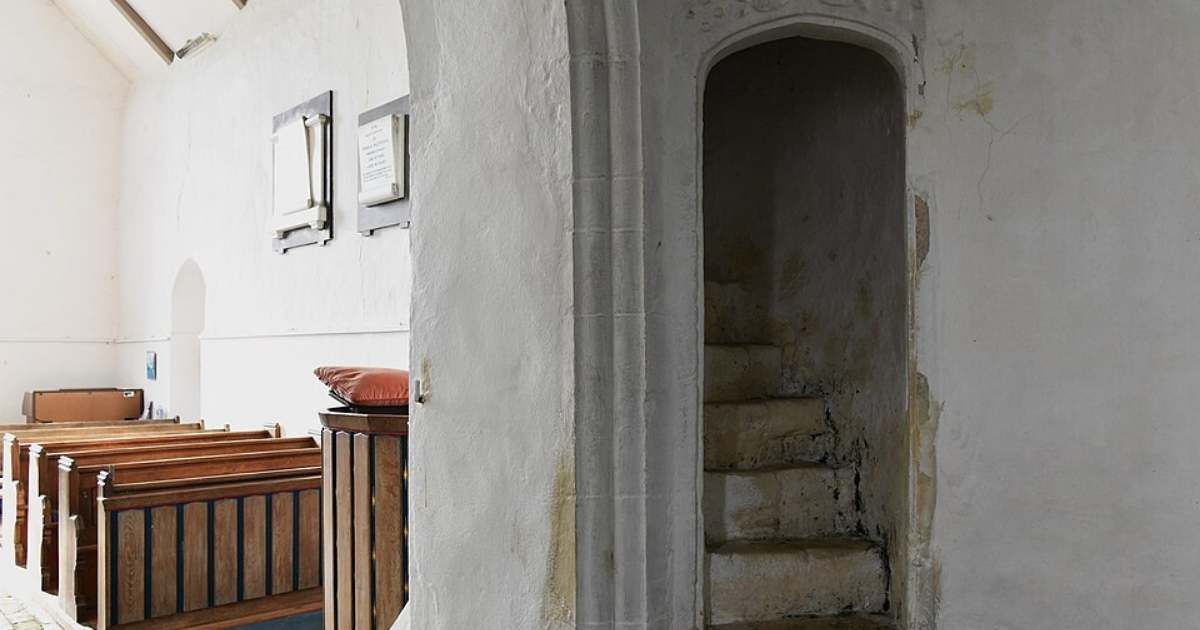
Medieval churches are full of mysteries, from secret chambers to unusual carvings. On July 22, 2026, historian, broadcaster, and author Dr. Amy Boyington (History with Amy) found another puzzling feature inside a medieval church in Norfolk. In a video she shared on Facebook, she stood next to a narrow hole in the wall with a spiral staircase leading up to the top. It looked like the steps led nowhere, and she could barely fit while trying to climb them. But they had an important use back in the day. She revealed it was called a "rood staircase." The video received 3.5 million views, 54,000 likes, and 930 comments.
To light the candles
Dr. Boyington explained that the rood staircase led to the "rood loft," which was a raised platform above the '"rood screen." The rood screen separated the main part of the church used by the congregation from the area used by the clergy. The loft often had groups of statues, including a statue of Jesus crucified in the middle, a statue of the Virgin Mary, and in some churches, a statue of St, John. The loft was also decorated with candles in front of the statues. The staircases were used to get to the loft to light the candles and trim the wicks because they had to be illuminated all the time. It was also believed that the loft was used as an "elevated platform" where the "sung word" or "spoken word" was shared with the congregation.
Why were they torn down?
Dr. Boyington also revealed that several rood screens were destroyed during the Reformation period. Under King Henry VIII's rule, the church was referred to as the "Church of England." It was no longer the Catholic Church. While the rood lofts and screens remained during his rule, they began to be removed during his son Edward VI's reign. Shrines, images, statues, and candlesticks were considered part of the 'old' Catholic church. By Elizabeth I's reign, the removal of rood screens was incredibly common because they were no longer needed. They were torn down, or the staircases were filled in since there was no need for the loft.
The last rood staircases
Despite their extensive destruction after the arrival of Protestantism in England, a few churches still had rood staircases and screens. Some of them include the Fritton St. Catherine church. The loft and stairs were restored during the early 1900s, but they were a replica of how they would've looked. Other churches that still have rood staircases include Bramfield Church and Lound Church.
Not for archers


People in the comments were making 'rood' jokes, and some even thought the windows next to the staircase were for archers. A few others expressed how claustrophobic the stairs looked. Maciej Mik commented, "I am super disappointed. I expected them to be so tiny because it would prevent a fully armored knights to go upstairs and kill the archers or something. I don't know. I'm disappointed, really." Wendy Caldwell pointed out regarding Dr. Boyington's comment about people fitting in the staircase, "One has to remember that people were generally smaller in Medieval times. You only have to look at the doorway height in some of the very old houses in Britain to see how we’ve changed."
You can follow Dr. Amy Boyington (History with Amy) on Facebook for more history-related content.
More on Scoop Upworthy
Archaeologists astounded after discovering secret chamber beneath 1500-year-old Istanbul church
 Share on Facebook


