In Antarctica, scientists can 'choose' what time it is
Technically, Antarctica falls under all 24 time zones, but in reality, that is not the case

Time zones are used to organize local time across different parts of the world. All time zones are measured from a starting point, known as the Greenwich Meridian or the Prime Meridian. However, Antarctica's unique location at the South Pole means time works differently on the icy continent. Technically, Antarctica falls under all 24 time zones, according to Antarctic Cruises. But in reality, that is not the case. Scientists and researchers who live on the continent use their own clocks and time zones for a variety of reasons, as also explained in an April 10 video by Cleo Abram (@cleoabram), which has gained 5.2 million views and 310,000 likes since.
Researchers follow their own time zones
Since Antarctica is 99% glacier ice, human habitation is extremely limited, which is why Antarctica does not have an official time zone. As mentioned, time works differently because of its location. Timekeeping is difficult because during the austral summer, Antarctica experiences 24 hours of sunlight, and 24 hours of darkness during the austral winter season. Since it is not owned by a single country or nation, scientists residing there do not have to follow a single time zone.
Every research station or camp follows the time zone of the country that operates it. One such example is the UK's Halley VI Research Station located on the Brunt Ice Shelf in the Weddell Sea. It follows Britain's GMT/UTC+00:00, as well as the British Summer Time/UTC+01:00.
80% of Antarctica has been claimed
Even though Antarctica is not owned by a single country, seven countries have made territorial claims over the continent that roughly covers 80% of Antarctica. Some of these countries include the UK, Chile, Norway, and Argentina. It is important to remember that these claims are not internationally recognized. Nonetheless, time is also different in these claimed areas. It follows the time zones of the claimant countries.
What did people do before time zones were introduced?
Before time zones existed, people updated their personal watches every single time they crossed from one town to another. During the 1800s, the U.S. had over 300 local time zones throughout the country. People used clock towers to denote the time, but in places with no towers, people had to find someone who knew how to reset personal clocks. The idea of time zones was finally introduced by Canadian engineer Sir Sandford Fleming in 1878. He wanted to divide the world into 24 time zones, every 15 degrees of longitude apart. The idea was finally approved in 1883 and was quickly adopted by different countries of the world.
Cruise ships follow their own time zone, too
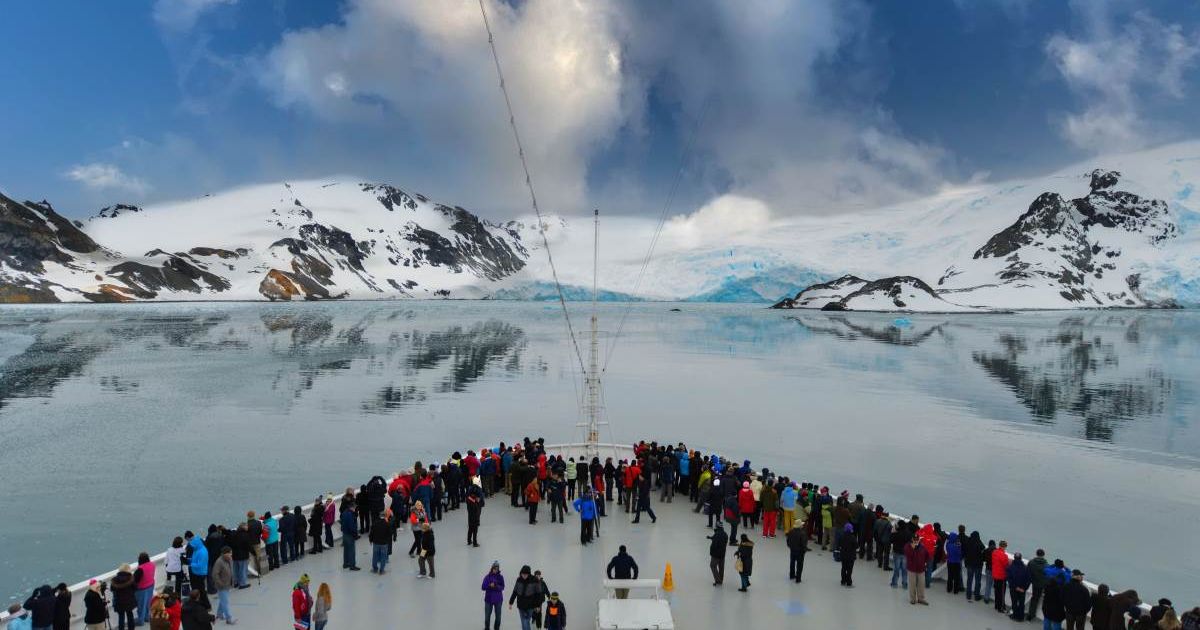
While the UK-based stations follow British time zones, three U.S-owned stations do not do the same. The McMurdo Station and Amundsen-Scott South Pole Station are U.S-based stations; however, they follow the New Zealand timezone because the country has its nearest supply base, or "whoever gives them food." Additionally, Palmer Station, owned by the U.S., follows the Chilean time zone for the same reason. While Antarctica does not have permanent residents, it does have visitors on cruise ships. How does time work for them? They often use the time zone of the port they left. Usually, cruises that depart from Ushuaia follow the Argentinian time zone.
You can follow Cleo Abram (@cleoabram) on Instagram for more fun science stories.
More on Scoop Upworthy
Scientists reveal the mystery behind the hole that appeared in Antarctica 8 years ago
Stunning footage of Antarctica’s rare ‘midnight sun’ captivates social media users worldwide
 Share on Facebook