Photos from space rarely ever show 'stars.' NASA explains why
People have long debated why stars don't show up in photos from space. Now, NASA has the answer

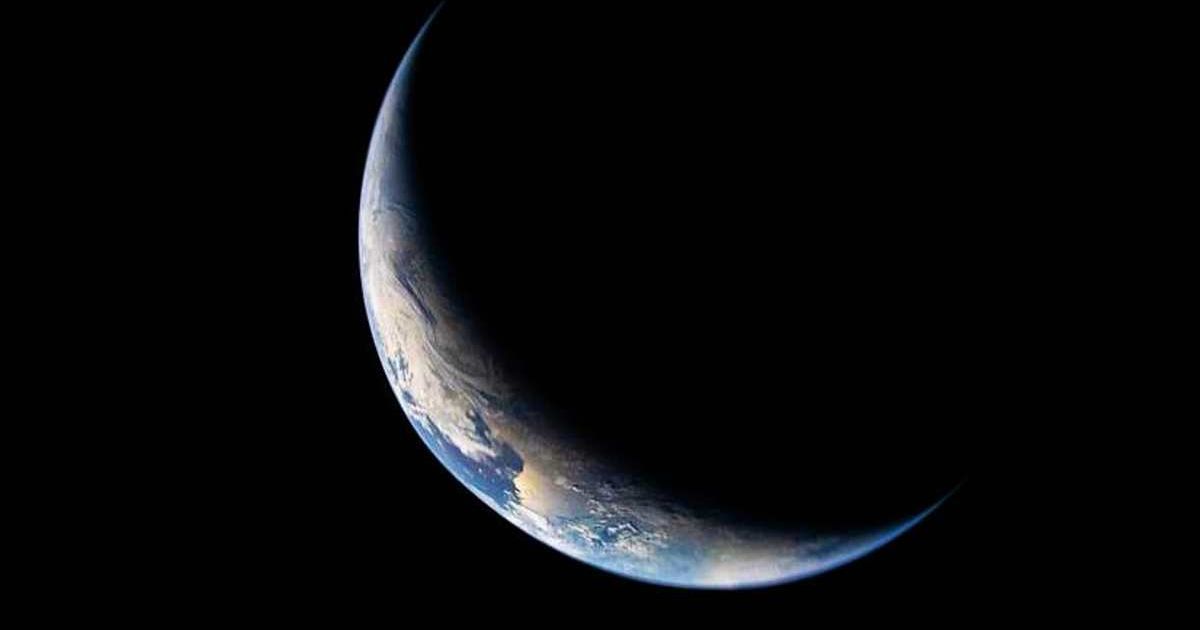
Ever since the astronauts from Artemis II shared space photos, people have been asking the same question they did years ago. 'Why are there no stars in space photos?' The official space images shared by NASA (@nasa) showed the Moon or the Earth in focus with a pitch-black space in the background. People are wondering if the photos were edited, and some even went as far as building conspiracy theories. But, NASA answered the question a year ago, and the reason is quite simple — it is all in the way cameras capture light and its settings. In fact, NASA Astronaut Christina Koch's April 9 post clarifies this best.
NASA explained in an Instagram post that the camera can only capture a limited range between the brightest and the darkest parts of space. Since the Moon or the Earth is really bright compared to the stars in the background, they tend to fade away in the photos. The camera settings and exposure have been adjusted to capture the details of the brightest object, making the stars dim and disappear into darkness. To understand better, try taking a photo of the stars at night next to a bright street light. The stars would not be as visible because of the bright object in front of them.
People want to know why there are no stars in the NASA videos/ pictures.
— Natalie F Danelishen (@Chesschick01) April 8, 2026
Go to a parking lot filled with lights
Look up
See how many stars you see
In space that’s the same issue. The sun causes a high contrast in photos and washes out the stars. They are seriously in the sky… pic.twitter.com/nsgE5UGFK7
Furthermore, NASA explained in detail that cameras control light with three settings. The shutter speed, which is responsible for how long the camera's sensor is exposed to light. The ISO, which is the camera's sensitivity to light, and the aperture, which is how wide the lens opens. It is possible to try to capture both the bright object and the stars in the background with the correct settings, but the image of the object in front would be blurry. Just because the stars do not appear in the photo does not mean they do not exist in space. It is simply the way the camera settings have been adjusted to focus and capture high-quality images of the object in front, be it the Moon or the Earth.
The most recent photo shared by Artemis II astronaut Christina Koch on April 9, proved that stars can be visible. She captured the eclipse with the sun hiding behind the moon. In the caption, she explained, "The Sun’s light reflecting off Earth, wrapping the Moon in a soft, borrowed glow." The image features a dark moon with a halo of light from the sun and a powder of stars in the background. This goes to show that when the object in focus is dark, the light of the stars can be captured on camera.
Netizens were in awe of the beauty that Christina Koch captured, and were grateful to witness an eclipse from space. @sabreenasframe commented, "You are such a bad*ss. I hope you guys can feel the love from us up there and can see the joy [you] guys are bringing us. Get home safe!" @mz.dianaa added, "Your descriptions of the Moon, of her colors and shapes and shadows, made me love watching her every night even more! From all of us moon lover girls down here, thank you! Can’t wait to see your smiles after safely getting home."
You can follow NASA (@nasa) on Instagram for more updates about the Artemis II mission.
More on Scoop Upworthy
Ex-NASA admin reveals why we waited 50 years to revisit the Moon
After 230 days in space, NASA astronauts could not even sit down when they returned to Earth
 Share on Facebook