Could mountains and rivers shape your accent? A poet says yes
Kae says it's just like how East Coast and West Coast rappers have a different 'sound.'


Kae Tempest appeared on Jessie and Lennie Ware's 'Table Manners Podcast' (@tablemannerspodcast) on April 19. They spoke about a myriad of topics, including lifestyle, Kae's tour, writing process, spirituality, religion, family, and even discussed why people have different accents. Kae explained how accents were influenced by the geography people grew up in, i.e., people in the hills have a distinct sound when compared to people living in the flatlands. A clip from the podcast was shared on Instagram, and it received 128,000 views and 3,035 likes.
Environment influences sound
The discussion about accents stemmed from Kae telling Lennie about the kind of rap he was into. He pointed out how different rappers from the East Coast and West Coast sound, just the way L.A. and New York have different looks. According to him, L.A. rappers had a more "bright" and "sunshiny" sound, and their raps tend to have an "aspirational" vibe to them. Kae also noted that accents of people from hilly areas have an "up and down melodic flow." Lennie, who heard this for the first time, was extremely interested to know more. He explained his point by saying, "Musicality of languages is often to do with what is happening to sound around us."
The quality of 'hills'
Lennie was surprised that hills have an impact on the melodic quality of an accent. Kae proceeded to give her an example of accents from the U.K. "But if you think about it, even within the U.K., the more hilly regions, the more mountainous regions, if you think about the Welsh accent, how melodic it is, and how beautifully it reflects the geography of the land," he explained while moving his hands up and down, referring to the rolling hills. However, Kae admitted that he did not know how long one had to live in a specific location for the landscape to have an "immediate effect" on the accent.
Ejective consonants
Anthropological linguist Caleb Everett from the University of Miami published a study that highlighted how geography can influence how language sounds. He found that 92 of the languages he was analyzing had ejective consonants. These are sounds made with an intensive burst of air and not found in the English language. The majority of these languages were spoken in places with high altitudes (4,900 feet or 1,500 meters). These regions include the Andes, the North American Cordillera, the Andean Altiplano, the southern African plateau, the Ethiopian highlands, and more. Everett's findings align closely with Kae's point on the podcast. Landscapes tend to have an impact on the way language sounds.

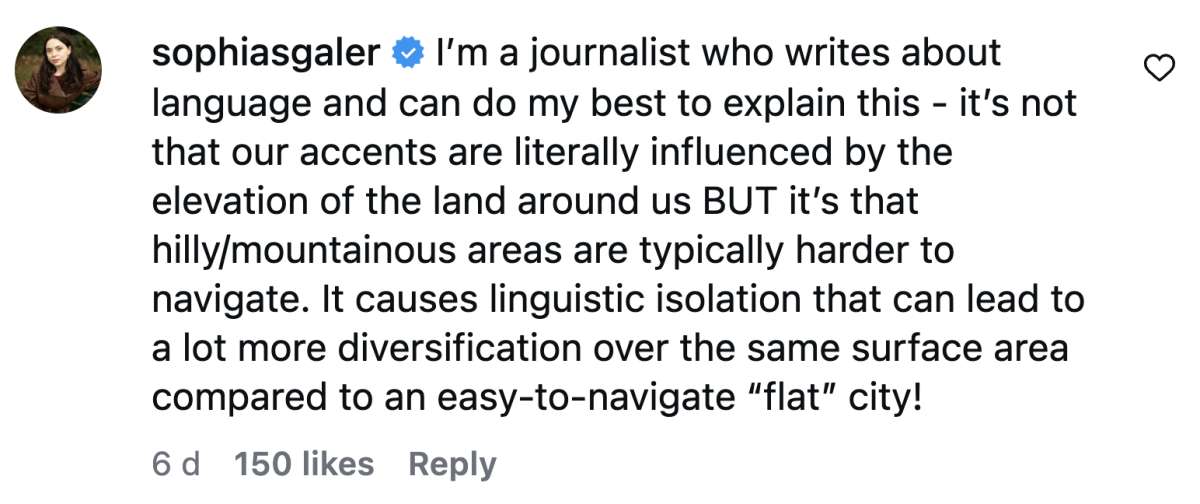
The comment section is a mix of people who agree and disagree with Kae. @vshawn.t commented, "Think of the movie, The Sound of Music, and how melodious Julie Andrews was singing in the Alps." @wellandtrulyfit shared, "I actually watched some mad documentaries about how accents evolved, etc., and language. Like how Scottish is like so argh rah rah because it’s like so f*cking cold and windy, and in Hawaii it’s all like sandy and everyone like purrs and hums just waves and sand innit."
You can follow Table Manners Podcast (@tablemannerspodcast) on Instagram for more interviews.
More on Scoop Upworthy
What did English originally sound like? A Linguist found out, and even the British are baffled
Study reveals how a brand new 'language' is gradually developing in the United States
World's simplest language with less than 150 words is enough to understand the meaning of life
 Share on Facebook


