Landlord kept forgetting to fix her damaged ceiling, then dared her to call the city. The inspection turned the tables on him
She mentioned the city’s code enforcement office, adding that the landlord could be fined for delaying the repair, but he didn't care


A tenant (u/octoberflavor) in New Haven unwittingly got pulled into a “cold war” with her landlord when she tried to obtain a repair for her chipping ceiling. For nearly three months, the landlord kept on postponing the repair appointment for reasons known only to her. At first, the tenant bit the bullet, but when the ceiling started dropping in huge chunks, she had no choice but to call a city inspector. The plot thickened when the inspection led to a series of quagmires in the house that needed repair or replacement. The tenant’s September 12, 2026, Reddit post has since amassed over 44,000 upvotes.
My landlord told me to go ahead and report her to the city, it did not go as planned
by u/octoberflavor in MaliciousCompliance
Contractors just forgot – 6 times
It started a few months ago when the tenant started to notice that the paint on her bathroom ceiling was chipping away. Despite a ventilation fan working, the moisture was cracking the paint, and the cracked paint was falling in huge chunks. So she approached the landlord, who promised to send contractors to fix the issue. Being a work-from-home person, the tenant offered her availability. But during the next three months, the contractors failed to show up on six different occasions. They weren’t even answering the tenant’s calls, nor were they responding to her texts.

A slippery slope
After three months, the tenant approached the landlord again to confirm whether she actually wanted to get the repairs done. She mentioned the city’s code enforcement office, adding that the landlord could be fined for delaying the repair. It was already way beyond the standard timeline. To her surprise, the landlord shrugged it off and proclaimed, "That is not relevant to me. File your claim with the city." That was it. It took her just five minutes to fill out the form on the office’s website. A call was scheduled for an inspector to come and investigate the matter.
When it rains, it pours
When the inspector arrived, they documented not just the peeling paint but a host of other problems. "They found a fire alarm that wasn't working, took note of the garbage around the property, and found windows that were boarded up in the basement that needed to be real windows to satisfy the city's 'at least 2 real windows in basements' rule or whatever," the author noted. Turned out there was also a mix-up of neighborhood wiring. Her upstairs neighbor had been paying for their kitchen, bathroom, and basement, while she had been unconsciously paying for her top floor. In a way, the landlord’s reluctance to help ended up benefiting the tenant, because now she’d receive all the repairs without shelling a penny.

Asking landlord for house repairs
Only due to landlords like these, so many tenants live in a catch-22 situation whereby they either have to put up with poor house conditions or risk an eviction notice. For instance, according to a report by Shelter England, three in four (76%) of private renters have experienced disrepair in their home. Of these, over half of the tenants (51%) had issues with damp and mold. Yet, a quarter of private renters (25%), just over two million people, did not ask the landlord for repairs out of fear of being evicted. Like the author, nearly one in four (24%) tenants struggle with leaks or flooding and 18% with mould, per the UNSW City Futures Research Centre study.
‘Research your local laws’
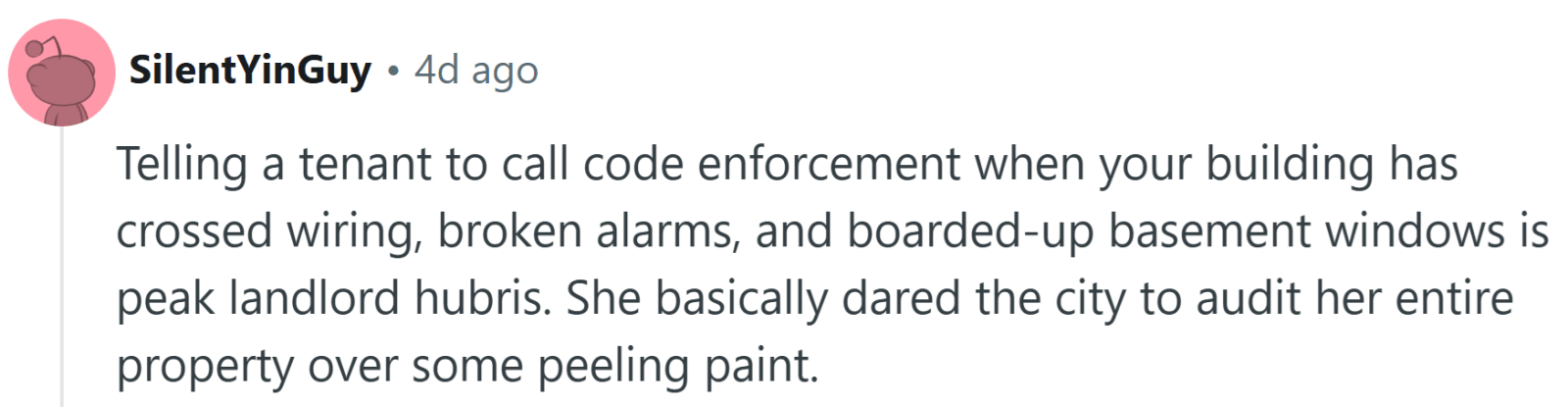

Readers urged the tenant to leave the stubborn landlord alone and approach the city council for repairs and improvements. u/kos-or-kosm said, “I don't get it. If she doesn't want to be bothered, then sell the damn house.” u/JerryVand suggested, “Depending on your state laws, paying for electricity used by another unit or by a common area could mean that the landlord is responsible for paying back any electricity costs back to when you moved in. You might want to do some research on your local laws.”
More on Scoop Upworthy
 Share on Facebook