Judge scolded attorney for seeking a psych test for a child’s father — until he found 2 fake cases ChatGPT had supplied to the judge
Adriane Capers' legal team searched day and night to review the cited cases, only to realize the catastrophic error


Artificial intelligence has crept into nearly every corner of daily life, but relying on it without checking its answers can become a dangerous gamble when a child's future is on the line and legal decisions are involved. In Stephens County, Oklahoma, an attorney representing a mother, Adriane Capers, fighting for custody of her child was denied a psychological evaluation by Associate District Judge Lawrence Wheeler. The decision seemed rock solid, as he based it on legal precedent. However, that changed when the attorney looked further and discovered that the cases Judge Wheeler relied on had been hallucinated by ChatGPT, as reported by News 9 on September 14, 2026.
A phantom custody precedent
The three-custody battle over Capers' child took a bizarre turn when her attorney petitioned the court for a mental evaluation, only to watch Judge Wheeler shut down the request. He did so by citing Cummings v. Cimarron Elevator Co. and Hawkins v. Linhart in his written order — two cases that his attorney later discovered did not exist. Suspecting something was amiss, Capers' legal counsel pulled the cases cited. However, they soon realized that these cases simply didn't exist. "He went in to file a motion against it being denied, started to look up the cases, and then he discovered that those cases did not exist," she explained. Moreover, she noted that her lawyer's entire team also then reviewed the cases but couldn't find them anywhere. The issue later became part of an investigation in which Wheeler admitted using ChatGPT for legal research. He said he wrote the order himself, but acknowledged that at least two of the case citations produced by ChatGPT did not exist.

Secret confessions and apologies
Once the fake citations were exposed, Judge Wheeler had no option but to back out of the courtroom. "He then turned around and decided to rescue himself from my case," Capers noted. She then revealed that he even issued an apology to her attorney at the time. However, the situation didn't end there. The Oklahoma Council on Judicial Complaints brought in the Oklahoma State Bureau of Investigation. During the OSBI investigation, Wheeler admitted that he had used ChatGPT for legal research, which gave him at least two cases that were purely made up. Meanwhile, the local district attorney, Jason Hicks, handed over the case to the state to keep things fair.

No criminal charges
The Oklahoma Attorney General's office reviewed the OSBI investigation and determined that the evidence did not support criminal prosecution. Judicial discipline, however, remains a separate matter for Oklahoma's judicial authorities. In the meantime, when asked about this messy situation, Wheeler's attorney said, "The Judge and I have no comment on this matter at the time." A judge has been appointed for the case, as Capers clarified that she isn't out for revenge. Rather, she explained that she wants people in power to do their homework when a family's future is at stake. "I feel like ChatGPT has a lot of positive aspects in it," she admitted.

People's trust in AI
It seems like Capers isn't the only one who believes AI has a lot to offer in the courtroom. That's because 53% of Americans believe that AI could have significant benefits for the justice system, according to a Rev survey. These benefits include case organization (33%), faster resolutions (30%), and lower legal fees (29%). But a striking 75% of Americans believe that AI should only be integrated into the system if it is disclosed to the public. As for recommending the length of a prison sentence or predicting whether a culprit is likely to commit a crime, only 10% of people believe AI should be trusted in such situations.
'Disbar. Removal from bench'
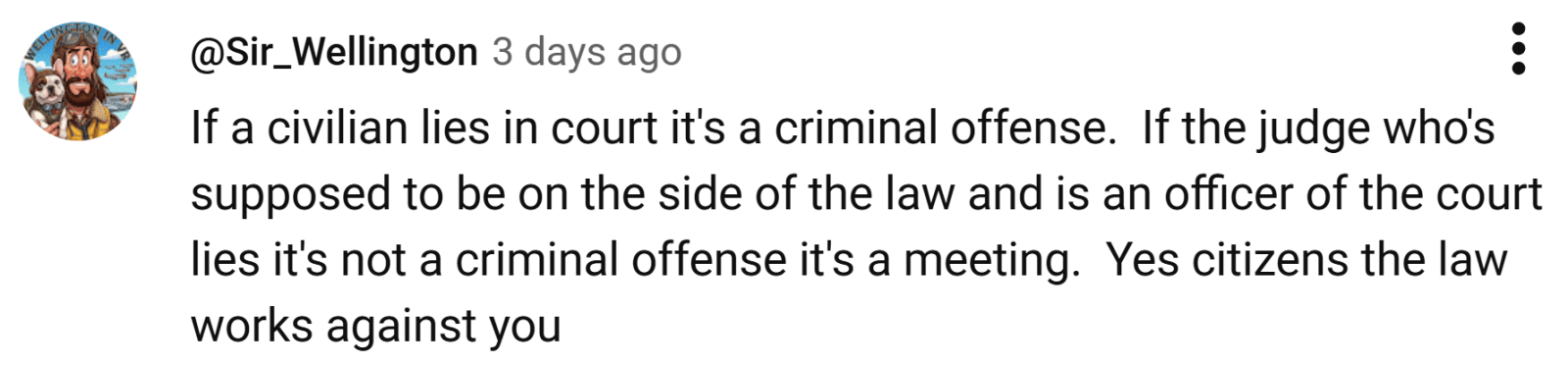

People, on the other hand, were furious with how Judge Wheeler handled this case. @melbasilio4517 noted, "Honest Judges look up the law to verify its actual CASE LAW before ruling on motions in family courts! JEESH!" Meanwhile, @ContentRemoved__ commented, "Intellectually lazy judge made false statements and blames a computer. Disbar. Removal from bench."
More on Scoop Upworthy
Mom flips out on Alexa after it made a chilling request to her toddler during a storytelling session
 Share on Facebook