Man checked the iPhone’s IMEI and receipt before sending the money. His bank stopped the transfer and pointed out a huge red flag he'd missed
Chris Bouli dismissed the red flags, convinced the deal was too good to pass up


Few retail highs match the quiet thrill of peeling the pull-tabs of a brand-new iPhone. But for Chris Bouli (@bouli.music), that nearly came with a brutal price tag. Convinced by an Apple Store bag, an invoice, and a seller who insisted that he boot the device to verify the settings matched the IMEI number printed on the box, Bouli thought he stumbled upon a once-in-a-lifetime deal. After paying via Interac e-Transfer, he drove away feeling on top of the world. But things changed when the seller told him to resend the funds to a different account. Unaware he was being scammed, Bouli went along, only to be saved by Scotiabank at the last minute. Later, he shared his entire tale on Instagram on August 14, 2026, racking up more than 86,500 views.
A deal too good
Lured by the promise of a factory-fresh iPhone from Facebook Marketplace, Bouli made the long commute from Hamilton to Toronto to collect the device. At first, he suspected nothing, as the seller arrived looking legitimate, carrying a branded retail bag and all the store documentation. "It was for a better deal than it should have been; that was the red flag number one," he recalled. However, Bouli ignored it because of the seller's cooperative demeanor.
Surprisingly, the seller urged Bouli to test every detail before finalizing the sale. "The girl told me, 'Hey, you can check the IMEI; you can open the phone. You can do everything. You can make sure the box is sealed,'" he explained. Bouli couldn't help but see that the woman was being very transparent. So, he opened the box and booted the phone. Sure enough, everything, including the IMEI number, matched. At this point, despite the incredibly low price, Bouli had no reason to believe the phone was fake, so he decided to purchase it.
ScotiaBank to the rescue
After sending an Interac payment, Bouli began his drive home, only to receive an urgent message from the seller. She said she hadn't received the funds. So, Bouli checked his phone and saw the payment was processing. But the woman insisted that he cancel that payment and send it to another account. Unaware that he was about to be scammed, he canceled the payment as instructed. But just as he was going to make the next payment, his banking app locked him out. Then he called ScotiaBank to find out what had just happened.
He asked them why the payment wasn't processed. "This email that you sent the money to — it's been reported for fraudulent activity in the past," the representative told him. They then gave Bouli two options: either he could push the payment further if he was convinced, or the bank would send the money back into his account. Thankfully, he chose the latter. Then Bouli went to a nearby mall, where an Apple store expert revealed it was fake. He thanked his bank for saving him while joking about getting a free phone.
Online scams
This story highlights increasing scams. It's no surprise that online purchases account for about 30% of types of scams across America, according to the Better Business Bureau's Scam Tracker Report. Among these reported scams, a staggering 87.5% of victims lose their money. This makes online purchase scams one of the highest-converting schemes. The same report revealed that emails were the biggest source of reported scam contacts. Moreover, it shows how helpful services like the one provided by ScotiaBank can save users from such scams.
'I got scammed by someone I thought was a friend'
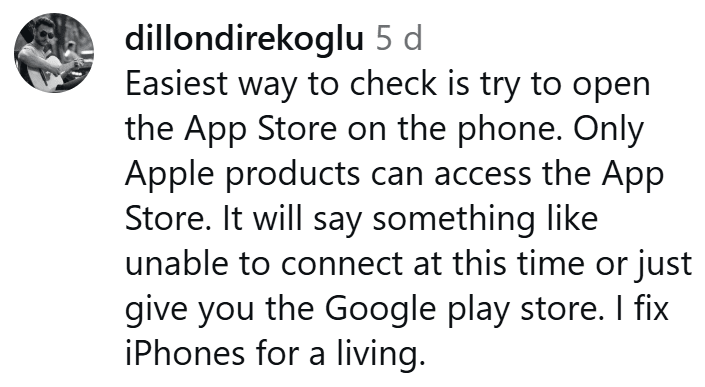
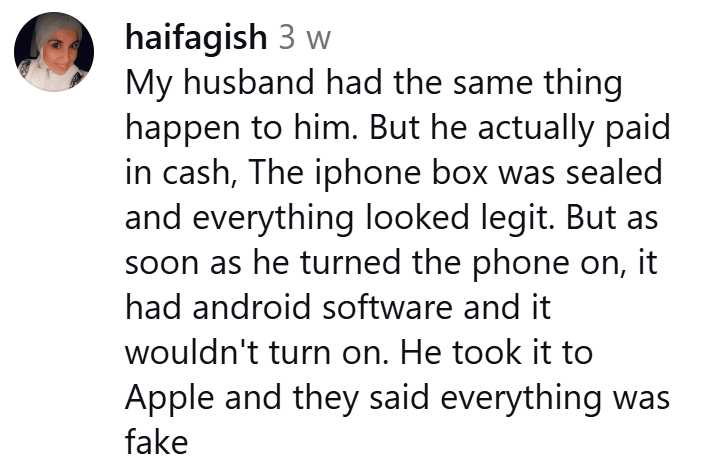
Bouli's experience also opened floodgates for other customers who've previously faced such scams. @stopped_watching_you_in_2023 noted, "FB Marketplace has almost only fake iPhones and Samsungs. Easy to tell when they say in a 'sealed box' and the price is way below retail. Often 'received as a gift.'" At the same time, @keepthefaith.g shared, "Well, I got scammed by someone I thought was a friend for a deal that sounded too good to be true as well, but I thought it should be a good deal; turns out not. PayPal refused to refund me."
Follow Chris Bouli (@bouli.music) for more music-related content.
More on Scoop Upworthy
Techie uses quick thinking and humor to scam a scammer and the internet is in splits
Man knowingly sent $500 to an African 'scammer' — ends up liberating a village
 Share on Facebook