Harvard analyzed 80,000 phone check-ins to predict suicide risk. One emotion emerged as a powerful warning sign
Professor Matthew Nock's pilot work revealed a major blind spot in how frequently dark thoughts struck and how long they lingered


Suicide risk is notoriously difficult to read from the outside. Someone can appear relatively stable during a clinical appointment, while their thoughts and emotions may shift dramatically hours or days later. That gap is what Harvard psychology professor Matthew Nock has been trying to understand. In a recent study, his team tracked hundreds of high-risk patients through frequent smartphone check-ins — and found that one emotion stood out as a particularly strong near-term warning sign, as reported by the Boston Globe on September 11, 2026.
Harvard study predicts most suicide attempts a week in advance. Research led by psychologist Matthew Nock forecasts 75 percent of suicide attempts and 87 percent of suicide-related crises before they occurred — a marked leap beyond existing prediction models
by u/Wagamaga in science
Roots in early tech
The foundation for this breakthrough started nearly two decades ago with far simpler hardware. Back in 2005, Nock turned to primitive Palm Pilots to record how frequently dark thoughts struck and how long they lingered. That pilot work exposed a major blind spot: internal turmoil shifts by the hour, yet standard care relies on monthly office check-ins. He pointed out that providers need better tools to help patients while discussing the gap in traditional health care.

Gathering real-time data
So, he decided to track these rapid swings. Nock's team enrolled more than 600 adults and adolescents across two medical facilities in the Boston area. Then, for the next three months the sent 20-question check-ins, which pinged the patients' devices six times a day. The questions included having to evaluate their pain on a sliding 1-to-10 scale. "We were looking for common signals like skin conductance, heart rate variability, and accelerometer data, which you can get from a cellphone or from a wrist sensor," he said, explaining they did so to measure how much the person was sleeping and moving through the day.

Surfacing key warning signs
After feeding roughly 80,000 completed surveys into predictive machine-learning software, the algorithms spotted patterns that clinicians routinely overlooked. Among the emotional states measured, agitation emerged as a stronger near-term predictor of suicide-attempt risk than depression. "While depression is an important risk factor, agitation also seems to be a really strong predictor of near-term suicide attempt risk," Nock revealed. Harvard reported that each additional point of agitation on the 0-to-10 scale was associated with an 11% increase in the likelihood of a suicide attempt in the following week.

Navigating data dropouts
Outside specialists noted the significance of this study that identified 75% of suicide attempts and 87% of suicide related events a week in advance. However, Dr. Katherine Musacchio Schafer emphasized that clinicians need clinical protocols rather than raw alert noise. Meanwhile, she also noted that patients dropping these check-ins is also a sign in itself, pushing researchers to look between the lines. Nonetheless, the long-term vision is to build something similar to the everyday weather radar, but for that, a lot of work needs to be done.
A stark rise in suicide rates
What makes this study's findings even more crucial is the unfortunate fact that suicide across the United States has been on the rise. According to the National Center for Health Statistics report, suicide rates within the country for people aged between 10 and 24 rose from 6.8 deaths per 100,000 people to 11.0 per 100,000 from 2007 to 2021. To put how bad the situation is into context in the meantime, the homicide rates in the U.S.A. declined from 2006 to 2014. This goes to explain why this study could be significant one for not just for the U.S.A. but for the entire world.
Views over answers
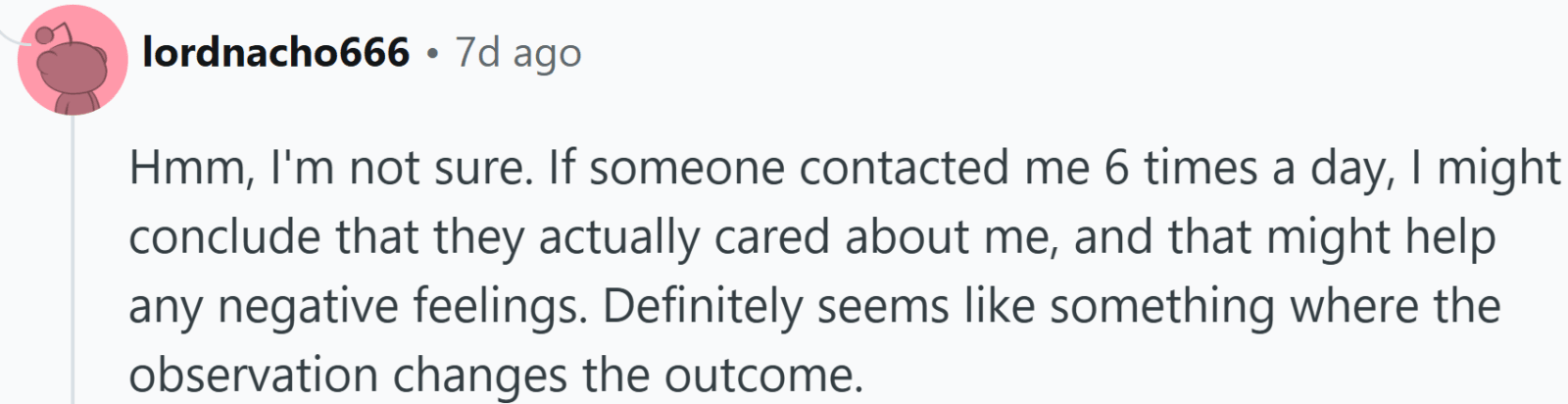

The people turned to a Reddit post by u/Wagamaga published on 10 September 2026 to express their views. u/AE_WILLIAMS wrote, "This seems like a perfect opportunity to create 'train-the-trainer' kinds of materials. It's a very easy win. And the benefits would be immense if you can take that methodology and use it for more mental health care." At the same time, u/iCliniq_official noted, "This is promising because it shifts the goal from reacting to intervening earlier. The important part is that these models estimate risk, not certainty; they're meant to help clinicians reach someone before a crisis, not label or predict an individual’s future. If this research helps even one person get support a week earlier, that’s a meaningful step forward."
More on Scoop Upworthy
A sea lion kept him afloat after he jumped off a bridge. Today, he's a suicide prevention speaker.
Student's powerful college essay about Mom's final act of 'luxury' is one every man needs to read
He was ready to give up — until a 92-minute talk with a patrol officer on the bridge saved his life
 Share on Facebook


