Girl brought home an AI photo of her future self from school — what she said about wanting to look that beautiful broke her mom's heart
'My initial reaction was — Am I allowed to be grossed out about this? I am grossed out about this,' the mother recalled

Artificial intelligence might make sense for data crunching, but it has no business touching a child's imagination. Yet, when a 32-year-old Nikki Anderson (@moms.who.write) unzipped her six-year-old daughter Harper's backpack, that line felt crossed. Alongside a messy construction-paper drawing, the South Carolina mother found an AI-generated portrait of her daughter aged into a 25-year-old nurse. It was seemingly meant to be a sweet classroom keepsake. Instead, it left Anderson unsettled, especially after what Harper said about wanting to look that beautiful. She vented through a lengthy Instagram post on October 17, 2026, garnering a lot of attention and amassing over 639,000 likes.
An unsettling backpack discovery
The controversy began when Harper returned home from her South Carolina elementary school with two items in her schoolbag. Alongside a colorful construction-paper drawing imagining her future, the first-grader carried an AI-generated portrait aging her into a 25-year-old nurse. Naturally, her mother was stunned to see her child's likeness altered and predicted by computer software, that too, without any warning. "My initial reaction was — Am I allowed to be grossed out about this? I am grossed out about this," she told PEOPLE.
Algorithmic standards of beauty
While Anderson hoped to discuss the handmade artwork, Harper was entirely drawn to the other picture. The six-year-old admired how the computer gave her flowing, wavy hair and expressed hope that she might actually grow up to look that pretty. Anderson noticed how quickly a digital rendering had shaped her daughter's budding self-esteem, and it broke her heart. "She doesn’t need a computer to tell her what she could become," she said, questioning why an elementary classroom would replace raw childhood imagination with machine-generated ideals.
Alarming questions over consent
Beyond the emotional impact, the realization that an educator had likely uploaded a minor's photograph to an external server triggered Anderson even further. She wondered where the image was hosted, which third-party platform had processed it, and who owned the data. Nonetheless, rather than publicly criticizing the teacher, she took her concerns directly to the principal and local board members, demanding systemic policy changes. She recognized that teachers are already stretched thin and shouldn't have to bear the weight all by themselves.
A fiercely divided web
Anderson posted about the incident on social media, where the story struck a chord with parents across the country. But while most of them shared her alarm over predatory data harvesting, others dismissed the project as harmless fun. Anderson acknowledged the parents' strong opinions on the topic, but argued that transparency should be made available regarding AI usage. That's something most parents would agree on. In fact, 79% of parents believe that schools should get permission from them before using AI in the classroom, according to a National Parents Union poll. Yet only 30% have been asked for the same.
It's not okay
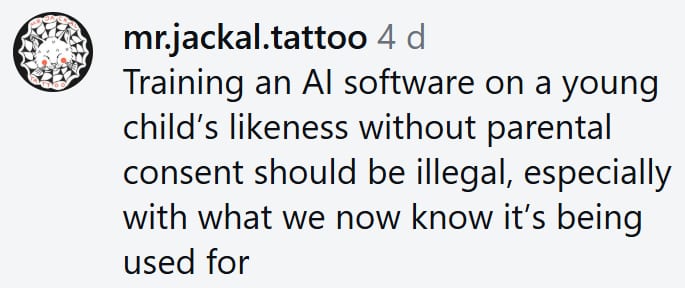
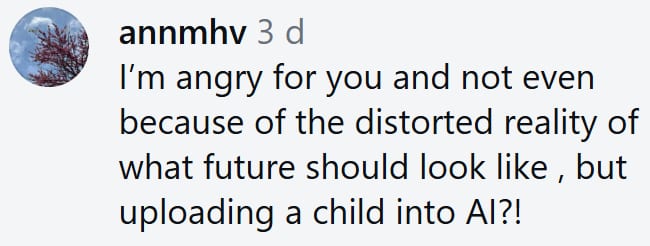
The same thought was shared in the comments as well. @_ggracieg9 commented, "And the AI photo STILL looks like a child! This is not okay." Meanwhile, @genujuan pointed out, "As a teacher, we are absolutely prohibited from uploading any identifying information into any AI sites. It’s a FERPA violation, as that information then belongs to the search engine/generator for public use."
More on Scoop Upworthy
Is AI making our brains lazier? A new study involving 350 Americans reveal a chilling answer
 Share on Facebook