Decision-making expert reveals why having a Plan B is killing your success
With no map to refer to, decision-making can make anyone's brain break. Simon debunks the science behind decisions to help people get out of the loop

Making a decision can make even the most confident people nervous. It is more “cutting off” than “choosing,” as the original Latin word "decidere" suggests. Decision-making expert and the host of the Courageously Curious podcast, Simon Veithen (@simonveithen), recently touched upon the fear and optionality aspects of decision-making in his video on March 20. Viewed more than 242,000 times, his video has left people racking their brains on how exactly they should make the big decisions of life.
“Why are you too afraid of big decisions?” Veithen asked and proceeded to share what he believed was life-changing. “People prefer to make changeable decisions rather than unchangeable ones, because they do not realize that they will be happier with the latter,” he said. Calling out the futility of keeping one’s options open-ended, he said it might not be the best idea.
“If you always keep your options open, your subconscious will not trick you into liking the decisions you made,” he explained. In contrast, if you commit and are unable to change the situation, your subconscious will be on your side and make the best of the situation. Veithen quoted a study from Current Directions in Psychological Science that labels this phenomenon as “affective forecasting.”

People often mispredict what they think would bring them pleasure or displeasure based on the biases left in their minds by emotional reactions and experiences of the past. Oftentimes, their decisions are based on these negative past events, psychological defenses, positive illusions, and coping mechanisms.
Veithen calls this a “psychological immune” system where a set of unconscious thought processes causes the mind to rationalize its decisions from distorted points of view.
For instance, when someone buys a sweater with a “no return” policy, they don’t have an option but to keep the sweater or buy another one. But if there is a return option available, the person might keep on thinking that they could get a better sweater than the one they have. In the study he referred to, scientists recruited a group of students and enrolled them in a photography class.
After taking multiple photos, the students had to choose one to be printed and let go of the rest. One group was allowed to change their choice a few days later, while the other had to stick with their initial selection.

"So one group made an irreversible decision, and the other made a reversible decision," Veithen explained. The team concluded that the group that made an irreversible decision turned out to be happier than the one that made a reversible decision. “So you avoid commitments; you avoid big scary moves in your life because you don’t realize that you will be happier than you think you will be,” Veithen said.
Ultimately, it’s not black-and-white, Veithen said, adding, “I’m not saying you’ll be happy no matter what, but it’s one factor that might contribute to your well-being.” But what about retrospective regret, someone asked. “So the next time you’re scared of a big decision, take a leap,” said Veithen. Other studies also show that the instinct to keep doors open isn’t as helpful as it feels in the moment.
A 2015 study found that around 66% of participants preferred having reversible choices, believing flexibility would make them feel more secure. However, those same participants reported lower satisfaction after making their decisions, largely because they kept revisiting alternatives and second-guessing themselves. In contrast, people who made firm, irreversible choices were more likely to settle into their decisions and feel content with the outcome.

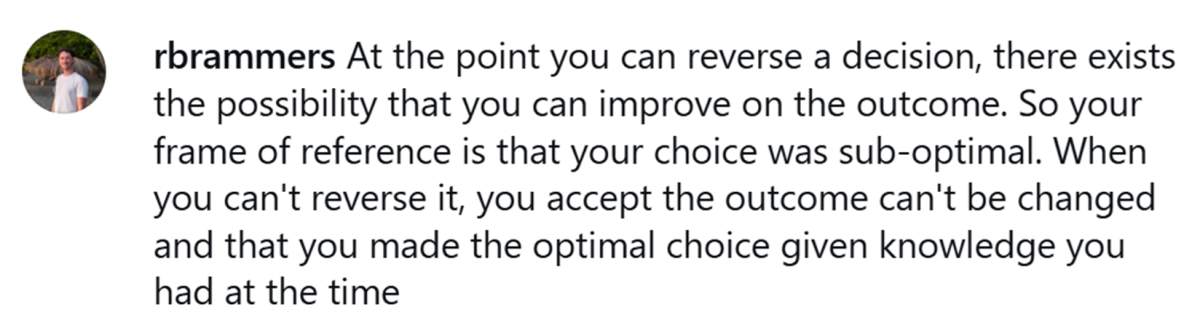
Veithen's views left viewers doubtful, skeptical, and jolted in cognitive dissonance. @lauraaroxana said, "Cognitive dissonance reduction is at it again. Works both to our advantage and disadvantage, though, which is why introspection and openly talking to friends about almost anything are so important." @rudygoel_ wrote, "Super cool how deep our psychology actually goes. I wonder how much we used this to our advantage when we didn't have SO much decision fatigue like we do today."
You can follow Simon Veithen (@simonveithen) on Instagram for more decision-making insights.
More on Scoop Upworthy
Expert who interviewed 70 parents reveals three ‘extreme’ parenting decisions that work wonders
10 personal stories of seemingly small decisions that lead to significant life changes for people
Manifestation expert shares simple method that stops people from worrying too much
 Share on Facebook


