HR reprimanded an employee for spending $50 extra to avoid a 3-hour airport wait. So they maliciously complied and ruined the boss’s date night
They booked the cheapest flight to follow policy instead of getting a direct flight home


Many companies implement policies that are more about reducing costs than being practical. An employee (u/drunclemuncle) shared how their HR pulled them for a chat after they followed their company's strict travel policy. It began when the employee opted for a slightly more expensive flight back from a work trip instead of spending three hours at the airport. Their decision, however, did not sit well with the HR, who called out the employee for overlooking cheaper options. Frustrated, the worker decided to abide by the rules, but it backfired when the stringent rule made their boss spend 4 hours at the airport on a Friday afternoon. The post was shared on April 29, and it has received 1,400 upvotes on Reddit.
The rule breaker
The company allowed its employees to plan their work trips, but they had to follow one simple rule: Book the least expensive option. The employee was well aware of the rule, but on one such occasion, they opted for a slightly more expensive flight that cost them an extra $50 to reach home sooner. Everything was fine until the employee submitted their expenses to the management. The management questioned them and gave them a warning after comparing their expenses with those of another colleague who followed the guidelines. After that incident, the employee decided to follow the rules and let it backfire on management. A while later, the employee had to accompany their boss on a work trip to London. "My boss would never book his own travel, so I had to do it for him," they recalled.

Malicious compliance
Instead of booking a direct flight back to their home airport in the US, the employee chose the cheapest flight available. The direct flight would have cost them $250 each, but they decided to follow company policy. The cheaper option landed them at JFK (John F. Kennedy International Airport) in New York, and they had to drive another hour home. Instead of landing at 1:00 p.m., they landed four hours late due to a layover. Because of the delay, the boss had to cancel date night with his wife. Annoyed, the boss asked the employee why they decided to book the late flight, and they told him about the policy. On Monday, HR summoned the employee and asked them to use their "best judgment" when booking flights. Even though the employee did not say it out loud, the company understood how its booking policy affected employees' time and tried to amend it.

Wage theft (in disguise)
More often than not, work trips turn into a nightmare for employees, especially when companies either refuse or delay the reimbursement. A survey of 1,000 American employees (by SAP Concur) found that 57% of respondents filed an expense report, and 60% of them experienced hassle in the process. In fact, while 19% have waited over three months for the reimbursement, 21% confessed to having paid interest or fees due to delays. Moreover, 35% have avoided work trips to prevent financial strains, and 30% have avoided submitting expense reports, fearing the annoyance. It means most companies choose cost-cutting over employees' comfort, which is what the person in the Reddit story experienced until they decided to teach management a lesson.

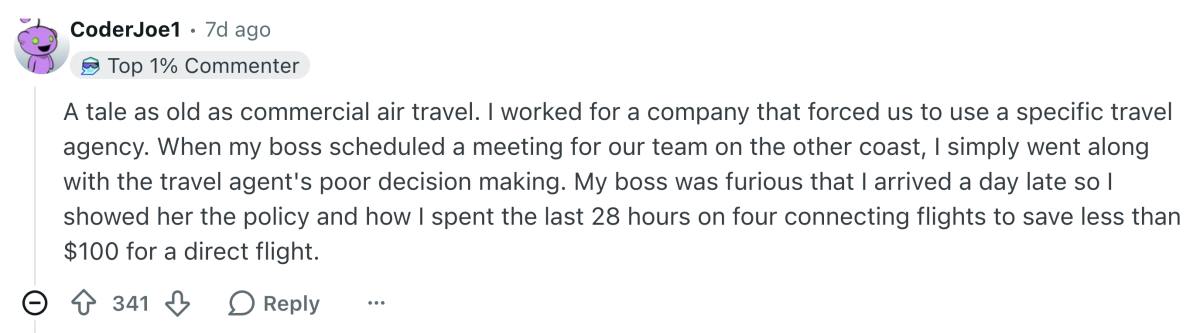
Meanwhile, people in the comment section applauded the employee for choosing the perfect moment to comply with the company's policy. For instance, u/vp-of-vibes commented, "Every corporate travel policy is really a document about whose time the company considers worth protecting; the rule says 'least expensive.' What it means is your time is fungible; ours is not. The policy change happens exactly when it starts costing someone whose time is considered scarce." Similarly, u/a_lovely_ shared, "I always liked to think about how they were paying me to sit in an airport, eating airport food = paying my per diem, all to save that $100.00."
More on Scoop Upworthy
Employee walks out in the middle of a work crisis after being told not to work overtime
Micromanaging boss punishes employee for following work process, ends up regretting it immediately
This article originally appeared 1 month ago.
 Share on Facebook