Dinosaur fossil sat in museum drawer for 100 years. Scientists just realized what it was
It measured up to four meters long and stood eye-to-eye with an adult human

The world is full of ancient secrets hiding in plain sight, waiting decades for someone to look at them a little closer. For nearly a century, one of them sat quietly inside a storage drawer at London's Natural History Museum, catalogued as an ordinary rock from the Isle of Wight. Researchers finally pulled the dusty specimen out and ran high-resolution scans on it. That was when the truth hit them. The research was published in Royal Society Open Science and was later picked up and reported by the Independent on October 13, 2026.
Forgotten in plain sight
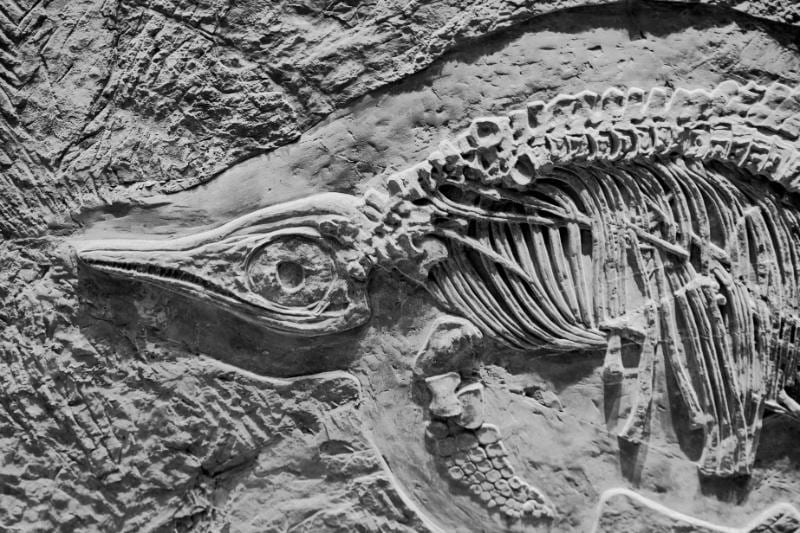
The journey began in 1924 along the rugged southwest coast of the Isle of Wight, where amateur collector Reginald Walter Hooley salvaged an ancient braincase from the base of a cliff. Following his death that same year, the fragment entered the archives of London's Natural History Museum, only to be tucked away and forgotten among thousands of other stones. "It is a real mystery that this fossil was overlooked for so long, sitting in a drawer for nearly 100 years," lead researcher Dr. Cassius Morrison said. For a whole century, paleontologists walked past the dusty box without realizing it held one of Britain's rarest finds.
Secrets beneath the scans
The turning point arrived when modern researchers pulled the bone out for high-resolution CT imaging, reconstructing a three-dimensional model of the cranial cavity. Instead of matching common local predators, the scan unveiled an oval spinal entrance and a distinct hourglass crest along the skull roof. Senior study author Paul Barrett noted, "Work like this shows the exceptional value of working with historical museum collections where there are still many discoveries to be made." The computational models confirmed the specimen was entirely distinct. It was a newly identified species.

Anatomy of an agile killer
Dating back to the Early Cretaceous, roughly 120 million years ago, this theropod was an agile carnivore rather than a bone-crushing giant. It measured up to four meters long and stood eye-to-eye with an adult human. "They definitely would have chased us," Dr. Morrison explained, noting that human-sized targets would make ideal meals compared to what giant carnivores bothered hunting. In its ecosystem, the Invictibellatriz amberina functioned much like a modern hyena, preying on small reptiles and early mammals.
Rewriting the prehistoric map
Beyond the beast's lethal tools, the revelation solves a longstanding mystery regarding how theropods conquered prehistoric landmasses. Scientists long suspected megaraptorans originated in Asia before migrating toward South America and Australia, but the complete absence of Europeans remains a glaring gap in the fossil record. As co-author Charlie Scherer pointed out, "This new species is the first proof we have that megaraptorans were also present in Europe." The find shows these hunters traversed northern continents during the Early Cretaceous before vanishing from Europe.
Popularity of dinosaurs in America
This latest find isn't huge just for the United Kingdom, but it will also make waves within the United States. According to a YouGov poll, 13% of adults in the country love dinosaurs, with another 31% stating that they like the prehistoric creatures. Of these people, a striking 19% name Tyrannosaurus rex as their favorite, which is a relative of this newfound species. This is followed by Velociraptor, which is loved by 6% of Americans, and Brontosaurus as well.
What other mysteries are hiding

People were impressed and curious at the same time about this discovery. Neil Bradley noted, "What else is in the archives just waiting to be rediscovered?" At the same time, Ratislav Brodziansky pointed out, "Given the fact that we have only explored 5% of the world's oceans, we are actually living in an alien world."
More on Scoop Upworthy
12-year-old fooling around on geology trip accidentally discovers 80-million-year-old fossil
Dad on hike with his kids uncovers rare dinosaur fossil — immediately calls paleontologist friend
 Share on Facebook