How empty bowling alleys 'signal' America's economic downturn
The public preferred local amusement parks and entertainment when they couldn't afford Disney World. Now it's a different scene


When you think of a country's declining economy, your mind immediately goes to inflation, unemployment, trade deficits, and other complicated economic terms. But in America's case, empty bowling alleys are one indication of its current economic state. On September 19, 2026, u/Separate_Advice_9212 asked Redditors what some "warning signs of a worsening economy" are in their line of work. More than 6,900 people shared their thoughts, and the post received 10,000 upvotes. u/Betaateb, who worked at an attractions company, gave a brief example of what they've observed at their workplace.
What warning signs of a worsening economy are you seeing in your line of work that the rest of us wouldn’t notice?
by u/Separate_Advice_9212 in AskReddit
Decline in the fun company
The person explained that their company sold to "fun centers, amusement parks, museums, science centers, bowling alleys, etc." In 2026, they saw a 25 to 50% decline in visitors. People are so "broke" they cannot afford to even spend money on gas to visit a free or inexpensive museum or science center. They also pointed out that their industry usually does not experience major downturns, except during the pandemic. They said the general public preferred local amusement parks and entertainment even if they cannot afford to go to Disney World, but "things are different this year, though. And it doesn't bode well."
A couple thousand bowling alleys left
A study by Dr. Randal S. Olson found that the number of bowling alleys has significantly declined since its peak in 1960. As per the industry estimates from the U.S. Census CBP (1986-2023), there were 4,600 bowling establishments in the 1940s. By the mid-1960s, they rose to 12,000 and spread all over the country. The boom was thanks to the introduction of the Automatic Pinspotter that replaced "Pin Boys."
The automation helped to create a more family-friendly environment. But its popularity was short-lived. A decade later, several bowling alleys began shutting down, and by 2023, only 3,154 remained in the country. The decline was mostly due to more women joining the workforce, the popularity of cable TV, and the arrival of the internet. Now, people used their leisure time in different ways.

The Chinese mirror
A Chinese study by Hongzhou Pei used the Chinese General Social Survey data from 2010 to 2015, and it painted a similar picture. It found that people living in a constantly declining economy had less time for leisure activities. Although there was an increase in educational activities, people spent less time performing active entertainment activities such as reading, listening to music, physical exercise, watching live sports games, and participating in cultural activities. This would explain why fewer people visited museums, bowling alleys, and other entertainment venues in America.

Older people spending more leisure time
Data from the U.S. Bureau of Labor Statistics also showed how much time Americans aged 15 and older spent on leisure and sports in 2024. The average American spent 5.07 hours a day on leisure and sports activities. Men (5.48 hours) spent more time on these activities, compared to women (4.67 hours). Among different age groups, people aged 75 and older spent the most time on leisure and sports activities, at 7.56 hours a day, likely because many are retired. Meanwhile, those aged 35 to 44 spent the least time, at 3.80 hours a day, most probably because they are working.
Eating in than dining out

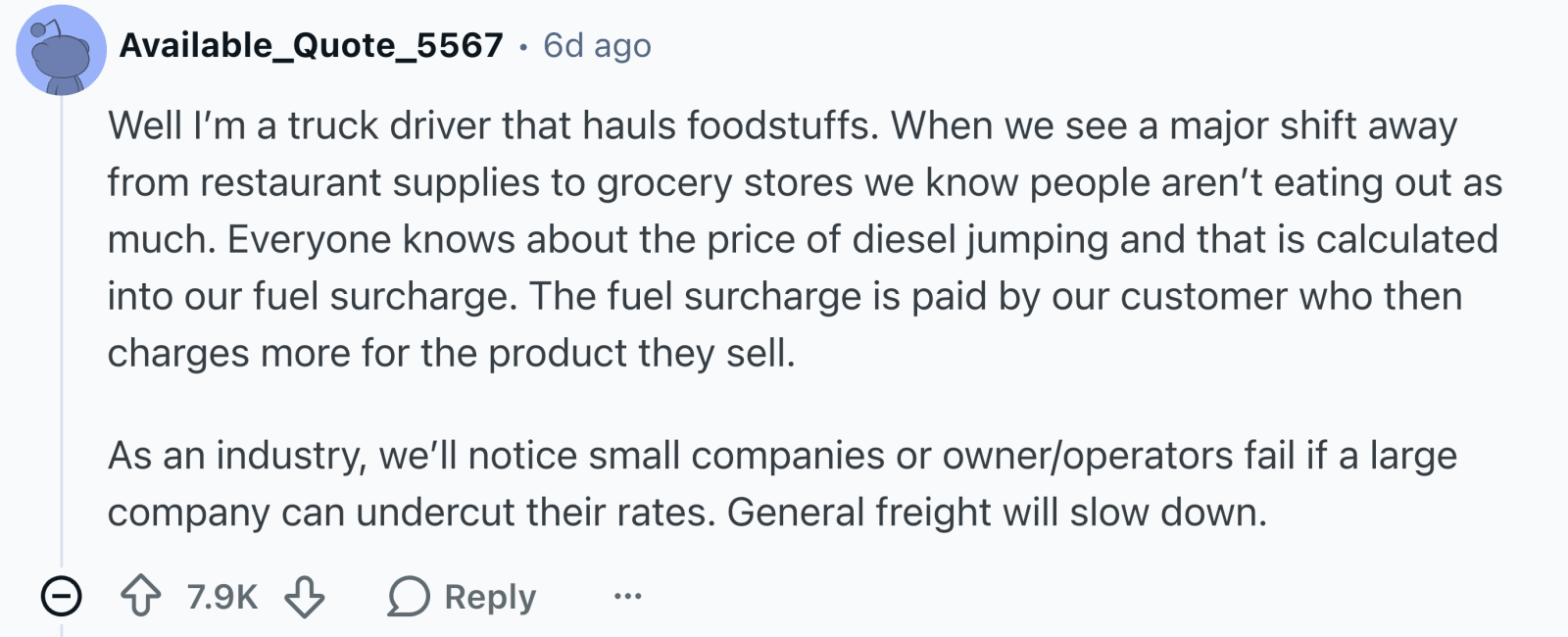
Several people shared specific examples from their own jobs. u/Normal_Rock_9748 commented, "Insurance. You wouldn’t believe the number of lapsed policies and pending cancellations from nonpayment." u/Here-Fishy-Fish-Fish added, "I'm a bankruptcy attorney, and we're busy."
More on Scoop Upworthy
Scientists examined 38 million obituaries and discovered what Americans really want from life
‘Stressed’ mom moves to Italy and discovers stark reality about life in America
Man compares today's economy with 'The Great Depression' revealing astonishing results
 Share on Facebook