3rd grader struggled to read in school but could read billboards. Then his teacher tried tilting his books
'Any type of surgery with your child is frightening,' Natalie admitted.

To Natalie Deakins, nothing about her son's falling grades was adding up. Jude Deakins could read roadside billboards with ease. Yet he struggled badly with books at Helen Wilcox Elementary School in Oroville, so he started acting out. Doctors at UC Davis eventually traced the problem to strabismus, an eye condition that threw off his depth perception. This discovery forced Natalie to consider sending Jude to be placed in special education. But before she could act on it, the third grader's teacher, Victoria Brothers, did her own research and spotted a simple fix everyone missed. This was then picked up by Action News Now (@ActionNewsNow) on November 8, 2026, racking up over 228,000 views and nearly 2,700 likes.
A frightening medical diagnosis
Trouble first appeared earlier when Natalie noticed Jude's left eye turning inward. After several medical visits, specialists at UC Davis diagnosed the third-grader with strabismus, a condition that affects proper eye alignment. The news shook his family, especially with surgery on the table. "Any type of surgery with your child is frightening," Natalie admitted. Meanwhile, his schoolwork slipped, and his frustration boiled over into classroom behavior issues. This led to school staff and the psychologist eventually meeting with Natalie to discuss placing Jude in special education.

Something didn't add up
Still, she couldn't shake the feeling that something was off. "It wasn’t adding up that he could read these street signs and he could read these billboards, but he was having so much difficulty with homework and in class," she recalled. In the meantime, determined to help her student, Brothers started her own investigation. Her research revealed that Jude’s strabismus caused stereo deficiency, making it hard for him to judge depth on flat surfaces. This made her come up with a simple fix that everyone missed.
A simple wooden solution
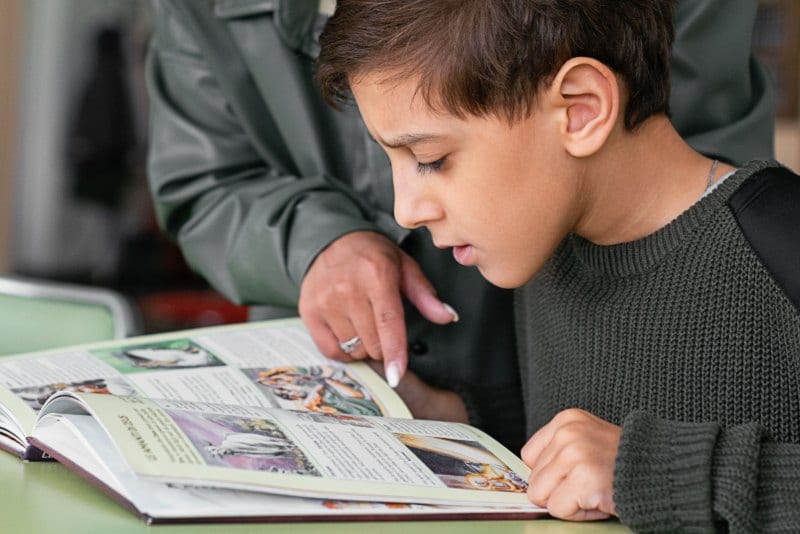
The breakthrough came in the form of an angled slant board. It was a tool Natalie hadn't heard about before. By propping the books and worksheets up at an angle, the angled board changed the position of the reading material and made it much easier for Jude to read. Sure enough, it worked, and the results were immediate. "Jude was reading the next day," Natalie said. Her son came home excited to show off his new tool, and his classroom confidence soared overnight.
A bright new chapter
The boy who once dreaded schoolwork now carries stacks of books to read for fun. Natalie was so moved that she wrote a letter to Brothers. In it, she compared her son's teacher to Anne Sullivan, the famous teacher of Helen Keller. She credited her and the Palermo Union School District for turning things around. For Brothers, who greets her students every morning as “my kids,” watching Jude thrive is reward enough. Now fully embracing school, Jude already has big plans to study bugs at UC Davis.
Eye health is crucial
Jude's story is a powerful reminder of just how important eye health is for children's development. The American Optometric Association (AOA) says about 80% of learning happens through the visual system and notes that undetected vision problems can affect academic performance, self-esteem, and classroom participation. "Unfortunately, children aren’t always able to tell you if there’s a problem," Dr. Ronald L. Benner, the AOA president, said. Hence, the AOA recommends comprehensive eye exams rather than relying only on basic screenings. This is also where adults like Brothers come into the picture, as they can read between the lines and provide the needed care to the kid.
A caring teacher and grateful parent


The people were left amazed by this inspiring story. @truepeacenik wrote, "I have this condition. You learn to adapt to a lack of depth perception (sort of like how we see depth in paintings); driving is definitely possible. I do it as a big part of my job. Jude, this doesn’t have to limit you in any meaningful way." At the same time, @cheryldavis1113 wrote, "This teacher is one of the best of us. I’m a retired first grade teacher. Teaching young children to read is an honor and a calling. Thank you to this awesome woman. She exemplifies what teachers do."
More on Scoop Upworthy
School teacher surprised by decades-old student, finally learns the impact she had on their lives
A struggling teen never thought he'd graduate — until his Special Ed teacher arrived home with proof
Parents of disabled children explain why ‘Welcome to Holland’ poem changed the way they saw life
 Share on Facebook


